
Living near the Chesapeake Bay comes with a lot of advantages. But for homeowners with crawl spaces, it also comes with a persistent challenge — humidity that doesn’t let up.
Damp soil in a 1,000 sq. ft. crawl space can release up to 12 gallons of water per day. That moisture has to go somewhere. And in a traditional vented crawl space near the water, it doesn’t escape — it builds up, feeding mold and accelerating wood rot beneath your floors.
Here’s the part most homeowners don’t realize: those foundation vents aren’t helping. Along the Chesapeake Bay, where humidity stays elevated year-round, vents pull moisture-laden coastal air directly into your crawl space rather than drying it out. Ventilation works fine in drier climates. Near Annapolis, it often makes things worse.
Crawl space encapsulation Annapolis addresses this problem at its source.
Best Buy Waterproofing has worked with homeowners Annapolis crawl space encapsulation long enough to understand what coastal humidity does to a home’s foundation — and what it takes to stop it. We’ll walk you through why encapsulation works where ventilation falls short, what the installation process looks like, and how to keep moisture under control year-round.
Quick Answer: How Encapsulation Addresses Coastal Humidity
Here’s the short version: encapsulation seals your crawl space completely — heavy-duty vapor barrier across the floor and walls, airtight vent covers, and a dehumidifier sized for coastal conditions. Together, these three components block moisture-laden air from getting in while keeping interior humidity actively controlled.
To understand why this works, it helps to know what’s going wrong in the first place. Warm, humid outdoor air flows through your foundation vents and hits the cooler surfaces inside your Annapolis crawl space — floor joists, pipes, ductwork. That temperature difference causes condensation, the same way a cold glass sweats on a summer afternoon. That moisture is what feeds mold and starts breaking down wood.
Encapsulation stops this cycle by keeping relative humidity below 55% — the point at which wood-destroying fungi become active. A properly sealed crawl space holds humidity between 40% and 55%, well below the 60% threshold where mold conditions take hold.
The vapor barrier handles ground moisture rising up from the soil, protecting your floor joists and subflooring. The dehumidifier takes care of anything left over. The result is a crawl space you’re actually controlling, instead of one that’s at the mercy of whatever the weather is doing outside.
There’s also a real financial case here. Homeowners typically see up to a 15% reduction in monthly heating and cooling costs after encapsulation, and Building America research documents energy savings as high as 20% in sealed crawl space systems. When you factor in avoided structural repairs, homeowners recoup more than 96% of encapsulation costs over time — a meaningful return, especially in a coastal climate where moisture pressure never really lets up.
Why Annapolis’s Coastal Climate Is Different From Inland Humidity
Proximity to the Chesapeake Bay keeps ambient humidity elevated year-round
Most of Maryland deals with humid summers. Annapolis deals with humidity year-round.
Sitting directly on the Chesapeake Bay, Annapolis maintains average ambient humidity around 72%. Come June through September, that number climbs to 76% or 78%. Inland Maryland homes get a break in summer — coastal humidity actually tends to peak in winter, while inland areas dry out. That inverted pattern means Annapolis crawl spaces never really get a rest from moisture pressure.
Tidal influence and high water table in Annapolis-area neighborhoods
Here’s something that surprises a lot of homeowners: the water affecting your crawl space isn’t always coming from above.
Tidal movement near the Bay creates cyclical shifts in groundwater levels. As those tidal waves push inland, they raise and lower the water table in a rhythm that doesn’t follow rainfall patterns. Wetland soils in tidal freshwater areas stay nearly saturated throughout the year. For homes with high water tables, a vapor barrier alone won’t cut it — sump pump integration becomes part of the solution.
Salt air and moisture-laden breezes adding coastal-specific moisture load
Salt doesn’t stay at the shoreline. Salt particles travel more than 50 miles inland on prevailing winds, and salt has a natural tendency to hold onto moisture. Surfaces stay damp long after the rain stops. That means coastal air carries a moisture load that goes well beyond what a typical Maryland homeowner further inland experiences — and your crawl space feels all of it.
Why Traditional Vented Crawl Spaces Struggle in Coastal Climates
Vents let in more moist air than they release in humid coastal climates
It seems logical — open the vents, let the air flow, dry out the crawl space. The problem is that logic doesn’t hold up near the Chesapeake Bay.
Research shows vented crawl spaces in humid climates actually increase moisture levels rather than reduce them. The air coming in through your foundation vents carries more water vapor than what’s already underneath your home. When average outdoor humidity sits around 70%, vented systems are essentially trading humid air for more humid air. Field research confirmed this: vented crawl spaces exceeded 80% relative humidity during spring and summer, while sealed encapsulated spaces held below 65%.
Ventilation was designed for a different climate. Annapolis isn’t that climate.
Summer humidity entering through vents condenses on cooler crawl space surfaces
Think about a glass of iced tea on a humid summer afternoon — water beads on the outside almost immediately. Your crawl space works the same way.
When 95°F air at 60% humidity drops to 75°F, condensation forms on floor joists, pipes, and ductwork. Dropping air temperature by just 20 degrees roughly doubles relative humidity. Crawl spaces run naturally cooler — they’re shaded and sitting directly against the earth. Add air conditioning running overhead with uninsulated ductwork, and the surfaces get even colder. Warm, humid air enters through the vents and condenses the moment it makes contact.
That moisture doesn’t evaporate. It stays, and it causes damage.
Why this problem is worse near the water than elsewhere in Maryland
Coastal homes deal with something inland properties don’t — salt air. Higher ambient humidity is one thing, but salty air actively promotes corrosion and moisture absorption in your building materials. Salt accelerates the breakdown of support beams and metal components while creating ideal conditions for mold.
The result is a combination of factors that makes moisture damage in Annapolis more severe, and more persistent, than what homeowners in other parts of Maryland typically experience.
Vented vs. Encapsulated Crawl Spaces in a Coastal Climate
So which approach actually works near the water? The difference between a vented and an encapsulated crawl space isn’t just technical — it shows up in your structural health, your indoor air quality, and your monthly energy bills.
A vented crawl space relies on foundation vents and outside air circulation to pull moisture out. The logic makes sense in theory. In practice, near Annapolis, the air coming in through those vents can be just as humid as what’s already sitting underneath your home. You’re not removing moisture — you’re replacing it.
Studies back this up. Vented crawl spaces in hot, humid climates frequently maintain higher moisture levels than encapsulated spaces, often pushing past 60% relative humidity. Above that threshold, you’re looking at real mold risk and the early stages of wood deterioration.
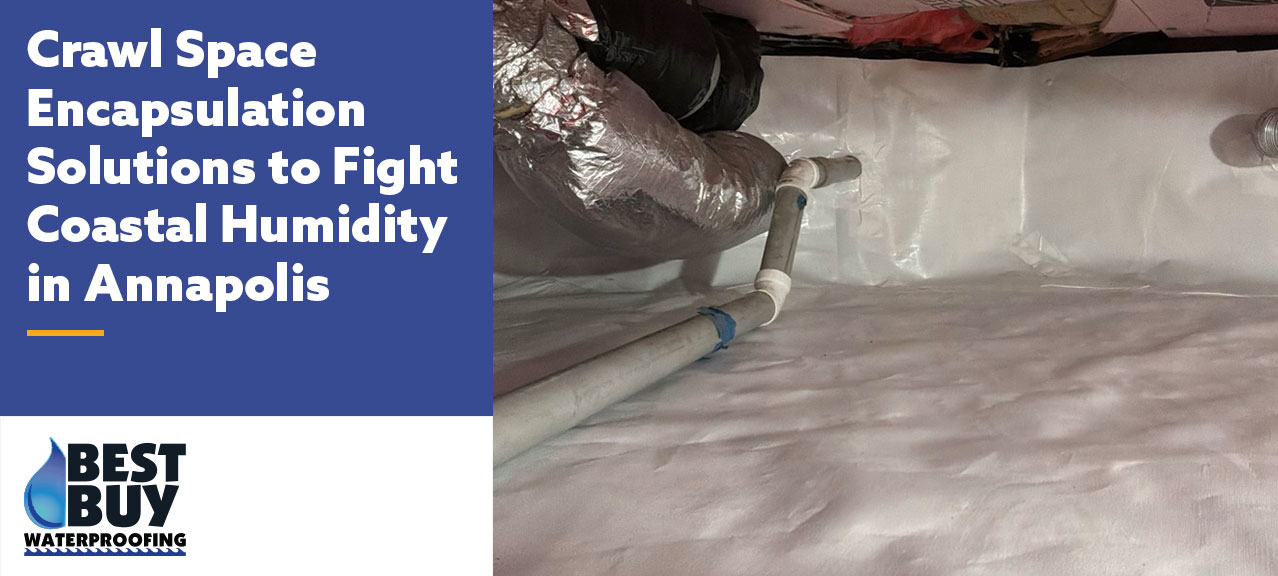
Encapsulation takes a different approach entirely. Heavy-duty polyethylene vapor barrier — typically 6 to 20 mils thick — covers the ground and foundation walls, sealing the space completely from outside air and soil moisture. The result is a closed system where you control the conditions below your home, rather than leaving them to whatever the Bay sends your way.
There’s another reason this matters. Research on the stack effect shows 40 to 50% of the air in your first-floor living areas originates from the crawl space below. A sealed crawl space stops contamination at the source — cleaner air beneath your home means cleaner air in your living areas. North Carolina researchers found that homes with sealed, insulated crawl spaces use 18% less energy for heating and cooling compared to identical homes with vented crawl spaces.
Near the Chesapeake Bay, that’s not a small distinction. It’s the difference between a crawl space that works for your home and one that works against it.
What Crawl Space Encapsulation Involves
Encapsulation isn’t a single product — it’s a system. Four components work together to control moisture in coastal conditions, and each one plays a specific role. Skip one, and the others can’t do their job properly.
A heavy-duty vapor barrier across the floor and foundation walls
The vapor barrier is the foundation of the entire system. Installation uses 10 to 20 mil polyethylene with a permeance rating of 0.1 or lower — that’s a Class I membrane, meaning it resists both ground vapor and the wear that comes from occasional crawl space access.
The barrier covers your entire crawl space floor and runs up the foundation walls, with seams overlapping 6 to 12 inches and sealed with specialized tape. Edges are secured using butyl tape and termination bars so the barrier stays in place permanently — not just for a season.
Sealing foundation vents completely
This one surprises a lot of homeowners. Encapsulation requires closing all foundation vents. Open vents and a sealed crawl space don’t work together — in fact, closing vents without completing full encapsulation can make moisture problems worse.
Building codes allow sealed vents when proper mechanical ventilation or conditioned air supply is in place. Your crawl space contractor will make sure everything meets code before the project wraps up.
Sump pump integration when the water table demands it
A vapor barrier stops ground moisture from rising through the soil. What it can’t do is stop water that’s actively pushing up from below. For homes near the Bay with a high water table, a sump pump isn’t optional — it’s part of the plan.
Submersible pumps rated 1/3 to 1 HP handle most residential crawl spaces. The system includes a collection basin, discharge pipe, and a check valve to prevent backflow once the pump cycles off.
A dehumidifier built for crawl space conditions
Standard household dehumidifiers aren’t designed for low-clearance spaces or continuous drainage — crawl space units are. They run differently, drain differently, and are sized specifically for the moisture load in your space.
One important note: sizing the dehumidifier depends on encapsulation being complete first. Without sealed vents and a proper vapor barrier, the unit runs nonstop fighting incoming humid air rather than managing a controlled environment.
Signs Coastal Humidity Is Affecting Your Crawl Space
Most crawl space moisture problems don’t announce themselves all at once. They show up gradually — in a smell here, a soft spot there — until the damage is already done. Knowing what to look for early can save you from a much more expensive repair later.
Here are the warning signs worth paying attention to.
Musty odor noticeable in rooms above the crawl space
That damp, stale smell isn’t just unpleasant — it’s a signal. Air naturally moves upward through the stack effect, pulling crawl space air into your floors, walls, and living areas. Up to 50% of household air originates from the crawl space. When mold or mildew is present below, that odor travels with it. If you notice it on the first floor, something is already growing underneath.
Visible condensation or dampness on floor joists and ductwork
Water droplets on concrete block walls, moisture beading on pipes, damp insulation sagging from floor joists, or discoloration on wood framing — any of these tell you humidity has reached damaging levels. Sweating ductwork is especially worth noting, since it creates the right conditions for both mold growth and structural damage over time.
Wood rot or softened framing
Press on a floor joist with your finger. It shouldn’t give. Wood moisture content above 19 to 20% creates conditions where wood-destroying fungi move in and start consuming structural wood fibers. Soft wood, wood that crumbles at the edges, or framing that feels spongy — these aren’t cosmetic issues. They’re structural ones.
Mold or mildew on insulation, subfloor, or stored items
Mold doesn’t need much of an invitation. Sustained humidity above 70% RH gives it everything it needs to start growing within 24 to 48 hours. Look for dark gray, black, green, or white fuzzy growth on framing, insulation, or anything stored in the space. Near Annapolis, where summer humidity regularly climbs past 76%, this isn’t a rare occurrence — it’s a real risk for any unprotected crawl space.
Persistent high humidity readings even on dry days
This one surprises homeowners. If moisture readings stay high even during stretches of dry weather, the problem isn’t coming from above — it’s coming from the ground or the surrounding soil. Readings above 18 to 19% wood moisture content put your home in the range where wood rot and mold growth become active concerns. Persistent elevated humidity, regardless of outdoor conditions, points to an underlying moisture issue that ventilation alone won’t fix.
Why This Matters Beyond the Crawl Space Itself
What happens in your crawl space doesn’t stay there. Air movement, structural load, and your HVAC system all connect what’s happening below your floors to the rooms where your family lives.
Humid air rises into the home through the stack effect
Warm air rises — that’s basic physics. As it escapes through upper-level openings in your home, it creates negative pressure that pulls air up from below. Up to 40 to 50% of the air you breathe on your first floor originates from the crawl space. That air carries mold spores, allergens, dust mite debris, and musty odors directly into bedrooms and living areas. If wood rot has already taken hold in your floor joists, you’re breathing the byproducts of that decay. It’s not just a structural problem — it’s an air quality problem.
Wood rot and structural concerns for floor joists over time
Once wood moisture content exceeds 20%, decay fungi activate and begin consuming structural wood fibers. You may notice sagging floors, squeaky boards, or doors and windows that suddenly don’t close right — all signs that weakened joists are failing under load. The floor system settles unevenly, creating stress that cracks drywall and pulls wall frames out of square.
The longer repairs are delayed, the more involved they become. What starts as simple joist sistering can escalate into structural remediation requiring temporary shoring and steel support installation. Catching moisture problems early is almost always the less expensive path.
HVAC systems working harder to manage humidity from below
Your heating and cooling system feels the effects too. Condensation forms on ductwork when 55°F conditioned air passes through crawl spaces sitting at 75°F and 80% relative humidity. Duct losses in unconditioned crawl spaces account for 25 to 40% of total HVAC energy consumption. Your system ends up cycling more frequently just to keep up, which accelerates wear on compressors and blowers over time.
Higher energy bills, more frequent repairs, shorter equipment life — these are costs most homeowners never connect back to what’s happening underneath their home.
What a Coastal Crawl Space Assessment Looks Like
Before any work begins, we need to know exactly what we’re dealing with.
Best Buy Waterproofing technicians start with precise environmental measurements — relative humidity, dewpoint, air temperature, and surface temperature — to get a clear picture of what’s happening in your crawl space. Wood moisture meters check your framing at multiple points. Anything at or above 19% moisture content signals active fungal decay risk, and we document it all.
Inspection of ventilation, moisture levels, and water table conditions
We evaluate your foundation vents, any existing vapor barriers, drainage patterns, and soil composition. Near Annapolis, we pay close attention to water table indicators — standing water, saturated soil, and persistent dampness that shows up even on dry days. Coastal properties near the Bay often have groundwater sitting much closer to the surface than homeowners expect.
Identifying existing mold, wood rot, or standing water
This is where we look closely at your joists and beams for microbial growth, check ductwork and pipes for condensation patterns, assess insulation condition, look for pest activity, and inspect foundation walls for cracks. Dark staining on soil, damp framing, and sagging insulation are all signs that moisture has already been doing damage.
Installing the vapor barrier and sealing vents
Before the barrier goes in, crews clear out debris, level the soil, and treat any existing mold. The installation itself is precise — full coverage across the crawl space floor with no exposed soil, seams overlapping 6 inches and sealed with specialized tape, edges running 6 inches up stem walls with mechanical attachment. No shortcuts. No gaps.
Integrating a sump pump if needed for water table conditions
Some Annapolis-area homes need a sump system before encapsulation can even begin. If groundwater rises from below, a vapor barrier alone won’t solve the problem. We position basins at the lowest collection points and route discharge pipes at least 10 feet from your foundation.
Installing a dehumidifier sized for coastal humidity load
Sizing matters more than most people realize. We calculate based on square footage, vapor barrier coverage, and the specific coastal humidity load your crawl space handles. Units are mounted on blocks with 12 inches of clearance and connected to condensate pumps or gravity drains for continuous operation.
Final walkthrough and humidity-level expectations
Once everything is in place, we walk through the results with you directly. Target humidity for your crawl space sits between 50% and 55% — that’s the range where mold and wood rot don’t stand a chance. A digital hygrometer stays in place so you can monitor conditions on your own after we leave. No guessing. No wondering if it’s working.
Maintaining an Encapsulated Crawl Space in a Humid Coastal Climate
Encapsulation does the heavy lifting — but it’s not a set-it-and-forget-it solution. Near the Chesapeake Bay, coastal conditions push materials harder than they would anywhere inland. A little routine attention goes a long way toward keeping everything working the way it should.
Periodic check of vapor barrier for tears or shifting
Every few months, take a look at your vapor barrier for tears, gaps, or sections that have pulled away from the walls. Small tears are an easy fix — waterproof tape handles those well. Larger damage is a different story and will need a professional to assess and replace the affected area.
Walk the space and confirm the barrier still covers the full crawl space floor with no exposed soil. Check that the sealant tape along the overlaps is still holding. Over time, settling can cause sections to detach from walls or supports — catching that early saves you from a much bigger problem down the road.
Dehumidifier filter and drain maintenance during peak humidity
Clean your dehumidifier filters monthly. Clogged filters reduce airflow and reduce how effectively the unit pulls moisture out of the air. Every few months, check the drainage line or condensate pump for clogs — algae and debris build up over time and can block drainage entirely.
Maryland summers are the real test. June through September, your dehumidifier works harder than any other time of year. That’s the window to stay on top of maintenance, not let it slide.
Monitoring for water intrusion after storms or high tides
After a significant storm or high tide event, get into the crawl space and look around. Check for water intrusion, damaged sections of the barrier, or signs of increased pest activity. Standing water needs to be addressed right away — left alone, it creates conditions for structural damage and mold growth that spread quickly.
Annapolis tidal flooding is a real factor that homeowners further inland simply don’t deal with. Your crawl space protection plan needs to account for it.
Annual inspection recommended given sustained moisture load near the Bay
Once a year, schedule a professional inspection. This isn’t just about what you can see — moisture meters detect problems inside framing and behind surfaces that a visual check will miss entirely.
The Bay doesn’t take a season off, and neither should your maintenance routine. Consistent care protects both your encapsulation system and the home it’s working to defend.
How Best Buy Waterproofing Approaches Coastal Crawl Spaces in Annapolis
Coastal crawl spaces aren’t the same as inland ones. The Chesapeake Bay changes everything — the humidity levels, the water table behavior, the salt air working against building materials year-round. You need a team that already knows this going in.
Best Buy Waterproofing serves homeowners across Maryland, Virginia, West Virginia, Washington DC, Pennsylvania, and Delaware. We’ve seen what the Mid-Atlantic’s soils, seasonal weather, and coastal communities do to crawl spaces over time — and we know exactly what it takes to protect them.
When we work on crawl space projects in Annapolis, we account for things that a standard inland contractor might miss: tidal influence on groundwater, salt air corrosion on materials, and humidity loads that don’t ease up even in winter. Our dehumidifier sizing and drainage planning reflect those realities, not a one-size-fits-all approach.
We use the highest quality materials available — because near the Bay, inferior products don’t last. Our spray foam insulation services work alongside encapsulation to tighten your home’s overall envelope, which means better energy efficiency and lower utility bills on top of moisture control.
We show up on time, treat your home with respect, and follow through on every commitment. Our work is backed by a lifetime transferable warranty — no fine print, no loopholes.
From the first inspection to the final walkthrough, your peace of mind is the goal.
Ready to Protect Your Crawl Space?
Chesapeake Bay humidity doesn’t slow down — and neither does the damage it causes underneath your home. The good news? You don’t have to just live with it.
Crawl space encapsulation gives you real, lasting control over moisture. Proper vapor barriers, sealed vents, and a correctly sized dehumidifier work together to keep humidity below the threshold where mold and wood rot take hold. That’s not a temporary fix. It’s a long-term solution built specifically for coastal conditions.
Best Buy Waterproofing backs every project with a lifetime transferable warranty — no fine print, no loopholes. Just the peace of mind that your home is protected.
If you’ve noticed musty smells, dampness, or just want to know where your crawl space stands, we’re here to help. Contact us today for a free inspection. You’ll meet with a certified inspector — not a salesperson — and walk away with honest answers and a clear plan.