
Standard fiberglass batts can absorb moisture like a sponge in below-grade environments, which is why many homeowners turn to spray foam. When comparing estimates, one of the biggest decisions is open-cell vs closed-cell spray foam. Both options offer better energy efficiency than traditional insulation, but their differences in moisture control, structural strength, and thermal performance matter most in Maryland, Virginia, and D.C. homes. The open-cell spray foam r-value is typically around 3.5 to 3.8 per inch, while the closed-cell spray foam R-value usually ranges from 6.0 to 7.0 per inch. Understanding vapor barrier properties and waterproof insulation performance is essential for basement insulation moisture control and any spray foam insulation crawl space project. That knowledge also supports mold prevention basement goals and effective crawl space encapsulation.
Understanding the Spray Foam Basics: What’s the Difference?
The choice between open-cell vs closed-cell spray foam comes down to what happens at a microscopic level. The foam’s cellular structure dictates everything from how it feels to the touch to whether it can stop water vapor cold.
Open-Cell Foam Structure and Properties
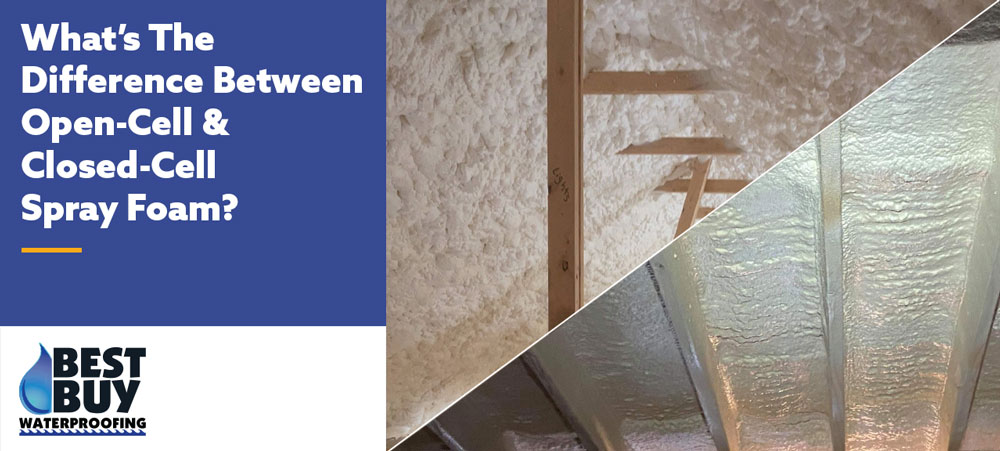
Open-cell spray foam gets its name from what happens during application. Professionals spray this polyurethane material and the tiny bubbles that form rupture, leaving behind only the struts where bubbles once touched each other. This creates a porous, interconnected structure filled with air.
The result is a material with a spongy texture you can compress by hand. Open-cell foam weighs about 0.5 pounds per cubic foot, making it lightweight and flexible. This low density allows the foam to expand roughly 100 times its original liquid volume, which explains why it fills wall cavities so aggressively.
Most open-cell formulations use water as the blowing agent, contributing to its environmental profile. The foam remains semi-rigid after curing and maintains enough flexibility to move with your home’s framing as it settles without breaking its air seal.
Closed-Cell Foam Structure and Properties
Closed-cell spray foam takes a different path. The bubbles don’t rupture during expansion. They remain encapsulated and packed together. Each cell gets filled with a gas that helps both expansion and insulation performance, creating a rigid barrier you cannot compress.
This structural difference produces a density of 2 pounds per cubic foot, making closed-cell foam about four times denser than open-cell. The foam cures into a rock-hard material that adds shear resistance to wall assemblies. You’ll need specialized equipment to trim it, whereas open-cell cuts easily with a knife.
R-Value Comparison: Open-Cell vs Closed-Cell
R-value measures thermal resistance. Higher numbers mean better insulation per inch of thickness.
Closed-cell spray foam delivers an R-value of R-7 per inch and provides maximum thermal resistance in shallow cavities. Open-cell spray foam r value reaches about R-3.8 per inch. Closed-cell achieves R-24.5 in a standard 3.5-inch wall cavity while open-cell reaches only R-13.3.
This near-doubling of insulating power makes closed-cell the practical choice when space is limited. That performance gap becomes critical for basement insulation moisture control applications where every inch counts.
The Moisture Factor: Waterproof Insulation and Vapor Barrier Properties
Moisture performance is the biggest difference in the open-cell vs closed-cell spray foam debate. Vapor barrier properties and waterproof insulation capabilities often determine whether a basement stays dry and protected or develops humidity and mold problems.
Does Open-Cell Spray Foam Absorb Water?
Yes. Open-cell spray foam absorbs water due to its porous structure. The material can absorb 5-10% water by volume when exposed to moisture. While this sounds problematic, open-cell behaves differently than traditional insulation.
The foam allows water to pass through rather than trapping it. Water moves through the interconnected cells and evaporates over time, like in concrete that absorbs rain and then dries. A small leak might dry within one to two days. Submerged foam could take longer depending on airflow.
Open-cell spray foam functions as a vapor retarder with a permeance rating of 15-20 perms. It slows but doesn’t stop vapor transmission. Open-cell remains unsuitable for flood-prone areas or locations with persistent moisture exposure because of this characteristic.
Is Closed-Cell Spray Foam Waterproof?
Closed-cell spray foam qualifies as waterproof insulation for practical purposes. The material absorbs less than 2% water by volume and resists moisture infiltration. Closed-cell creates a vapor barrier that prevents vapor from permeating through building assemblies at 1.5 inches thickness.
The vapor permeance rating sits between 0.8-1.5 perms and blocks moisture transmission. FEMA classifies closed-cell spray foam as a flood-resistant material that maintains structural integrity during flooding. Prolonged submersion can degrade performance, but installed closed-cell repels water rather than absorbing it.
Mold Prevention Basement: Which Foam Wins?
Closed-cell spray foam dominates basement applications to prevent mold. Mold requires moisture and food sources to thrive, along with temperatures between 40-100°F. Closed-cell disrupts the moisture component. It blocks humid air from entering wall cavities and prevents condensation on cold surfaces.
Open-cell’s moderate moisture resistance creates risk in below-grade environments where humidity accumulates. Closed-cell applied to basement walls reduces relative humidity levels and eliminates condensation formation points. This provides superior protection for basement insulation moisture control and crawl space encapsulation projects.
Where to Use Each Type in Below-Grade Spaces
Below-grade spaces require a different insulation strategy than upper levels. Basements and crawl spaces face ongoing exposure to ground moisture, humid air, and condensation, so the right foam choice has a direct impact on long-term performance.
Spray Foam Insulation Crawl Space: The Gold Standard
Closed-cell spray foam is the best choice for a spray foam insulation crawl space project in below-grade conditions. Research by Steven Winter Associates shows that placing water-tolerant insulation directly against foundation walls delivers consistent results. Closed-cell spray foam helps keep moist interior air from reaching cold surfaces where condensation forms, making it a reliable option for crawl space encapsulation.
Because open-cell foam is moisture-permeable, it is not a good fit for crawl spaces. These below-grade areas are difficult to keep perfectly dry, and bulk water or persistent humidity can lead to significant absorption, damaged finishes, and ongoing moisture issues. For that reason, many contractors in Climate Zone 5 recommend a spray foam insulation crawl space system built with closed-cell spray foam and thick plastic vapor barriers.
Basement Insulation Moisture Control for Rim Joists
Rim joists account for 15% to 25% of total home heat loss. They rank as the second biggest heat loss area after attics. The concrete foundation-to-wood connection creates air leakage, while the interior rim joist surface becomes a cold condensation point in winter. Moisture-related problems in basements start at rim joists 80-90% of the time.
Spray foam provides both insulation and air sealing in one application. Closed-cell adds rigidity and blocks 99% of air infiltration. It creates moisture barriers that reduce mold and wood rot risk. Building codes permit exposed spray foam at rim joists without thermal barriers when thickness stays under 3.25 inches.
Upper Levels: When Open-Cell Makes Sense
Open-cell excels in attics and interior walls where moisture exposure remains minimal. The material offers sound-dampening properties and cost advantages for spaces not requiring moisture resistance. Budget-conscious projects benefit from open-cell’s flexibility in above-grade applications.
Contact Best Buy Waterproofing Today!
Don’t let the wrong insulation undermine your basement waterproofing efforts. In the open-cell vs closed-cell spray foam comparison, closed-cell is the clear winner for below-grade applications in Maryland and Virginia homes. Its waterproof insulation performance, vapor barrier properties, and higher closed-cell spray foam R-value make it the better choice for basement insulation moisture control and crawl space encapsulation projects.
Want to seal your lower level? Contact the team at Best Buy Waterproofing today for an evaluation of your crawl space or basement insulation needs.