
Most foundation problems don’t announce themselves all at once. They start small — a crack here, a sticking door there — and grow slowly while life goes on around them.
That’s what makes foundation damage so costly for Fairfax homeowners. Northern Virginia’s expansive clay soil, seasonal freeze-thaw cycles, and drainage challenges create the kind of relentless, year-round pressure that gradually chips away at your home’s structural integrity. By the time most homeowners notice something is wrong, the damage has already been building for months or even years.
Knowing what to look for makes all the difference. Bowing basement walls, diagonal cracks in drywall, sloping floors — these aren’t just cosmetic issues. They’re your home telling you something is wrong beneath the surface.
The good news? Catching these signs early keeps Fairfax foundation repairs manageable and protects your property value.
Best Buy Waterproofing is here to help you spot the warning signs — inside and out — understand why Fairfax soils are uniquely hard on foundations, and find the right repair solution to protect your home for the long haul.
The Top Warning Signs Inside Your Fairfax Home
Your home will tell you when something’s wrong — you just need to know what to listen for. These interior warning signs are often the first clues that your foundation needs attention.
Windows and Doors That Stick or Jam
This is one of the earliest signs homeowners notice. When windows suddenly need extra force to open, or doors jam in their frames without explanation, uneven foundation settlement has likely distorted the openings. Non-functioning locks are another clue — they signal that frames have shifted out of alignment.
Pay attention to where the sticking happens. Exterior doors that drag or bind typically point to foundation settlement, while interior doorways jamming often indicate crawl space support failure. The location matters because each situation calls for a different repair approach.
Diagonal Cracks in Drywall and Plaster
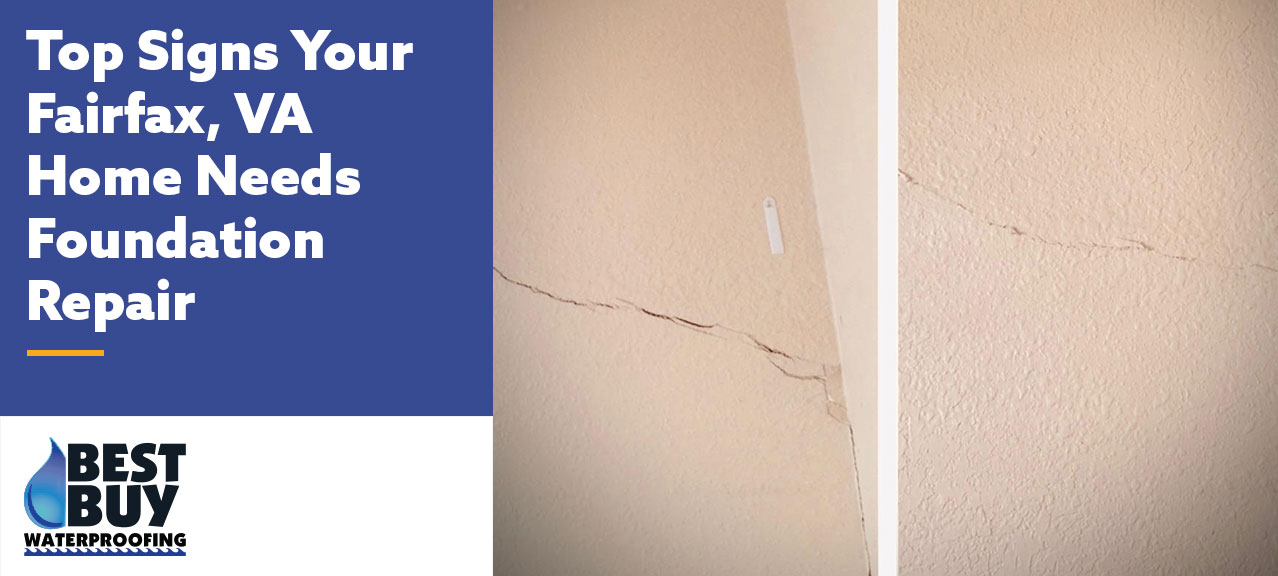
Diagonal cracks running from the corners of doors and windows are the single most reliable indicator of foundation settlement. Unlike wood framing, which can flex and bend under pressure, drywall is rigid — so it cracks instead. These fissures appear where structural stress concentrates most, right at the corners of openings.
If you’re seeing this pattern in your home, don’t dismiss it as normal settling. It’s your home’s structure signaling that something beneath is moving.
Uneven, Sloping, or Squeaky Floors
Walk through your home slowly and pay attention to what you feel underfoot. Soft or bouncy spots, a noticeable slope toward one side, or dips in corners and room centers are all warning signs. Squeaky floors often point to structural movement that has caused floorboards to shift or warp.
Foundation settlement pulls floors downward in affected areas. When crawl space supports are failing, you may notice uneven surfaces throughout an entire section of the home rather than just one spot.
Gaps Around Door Frames, Trim, or Exterior Chimneys
Gaps between door frames and walls are easy to overlook at first — but they signal structural separation caused by foundation movement. Sometimes these gaps appear at ceiling-to-wall joints even before visible cracks develop.
Gaps around exterior chimneys deserve particular attention. Chimneys are heavy and sit on their own footings. When settlement causes separation between the chimney and the main structure, it’s a sign that different sections of your foundation are moving at different rates. Beyond the appearance, gaps like these can prevent locks from engaging properly — a safety concern worth addressing quickly.
Seeing multiple gaps alongside any of the other signs listed above? That combination warrants a professional foundation inspection sooner rather than later.
Basement and Exterior Red Flags to Watch For
Your basement walls and exterior brick don’t lie. When foundation problems develop, these areas show the clearest, most direct evidence — and what you find here often determines how urgent the repair needs to be.
Bowing or Horizontal Basement Wall Cracks
Horizontal cracks are a serious warning sign. They mean heavy soil pressure is pushing against your foundation from the outside.
When soil becomes saturated from rain, snowmelt, or poor drainage, it expands and builds hydrostatic pressure against your basement walls. Over time, that lateral force causes walls to crack horizontally, bow inward, or tilt. Block foundation walls are especially vulnerable — they’re hollow and offer less resistance to that pressure than poured concrete.
Bowing walls don’t stabilize on their own. Without repair, they can buckle or cave in entirely. If you’re seeing horizontal cracks — especially with any inward displacement — don’t wait on this one.
Stair-Step Cracks in Exterior Brick Mortar
Noticed a zigzag pattern running along the mortar joints in your exterior brick? That’s a stair-step crack, and it’s telling you your foundation has settled unevenly.
Mortar joints are the weakest point in a brick wall — they give way before the bricks themselves do. These cracks tend to show up at corners or near door and window openings, where settling concentrates stress. Different sections of your foundation shifting at different rates create that characteristic staggered pattern in the masonry.
It’s not just a cosmetic issue. Stair-step cracks signal real soil movement beneath your foundation.
Water Intrusion and Efflorescence
See a white or grayish powder on your basement walls? That’s efflorescence — crystalline salt deposits left behind when water moves through your concrete or masonry and evaporates on the surface.
Efflorescence itself isn’t a health hazard, but it is a moisture indicator. Active water is moving through your foundation walls. If that powder keeps coming back after rain or gets worse in humid months, ongoing water intrusion is the cause.
Left unchecked, that same moisture can encourage mold growth, rust the rebar inside your concrete, and weaken your foundation’s structural integrity over time. It’s worth taking seriously well before it reaches that point.
Why Fairfax, VA Soils Are Uniquely Hard on Foundations
Most homeowners are surprised to learn that expansive soils, frost heave, and soil compression cost American homeowners seven billion dollars every year. Half of all homes in the United States sit on expansive soils, and a quarter have already seen damage from them. Fairfax properties sit right in the middle of that risk zone — and the local soil conditions make things even more challenging.
Here’s why Northern Virginia is particularly tough on foundations.
The Expansive Clay Soil Problem in Northern Virginia
The clay soil common throughout Fairfax County isn’t ordinary dirt. It contains montmorillonite clay minerals that can swell up to fifteen times their dry volume when they absorb water. These soils push against foundation walls with pressures exceeding 30,000 pounds per square foot.
Clay-rich soils from the Potomac Formation — widespread in this region — hold onto water long after the rain stops, unlike sandy soils that drain quickly. Spring storms saturate the ground, and the clay expands and presses hard against your foundation. Then summer heat dries it out, the soil contracts, and voids open up beneath your foundation sections. This expansion-contraction cycle repeats season after season, wearing down concrete and masonry over time. It’s the primary driver behind the diagonal cracks, sloping floors, and wall damage we see on Fairfax properties every day.
Freeze-Thaw Pressure During Winter Months
Water expands roughly 9% when it freezes. That might not sound like much, but when soil moisture freezes several feet deep along the frost line, that expansion pushes hard against your basement walls — sideways. Then daytime temperatures rise, the ice thaws, and the cycle starts all over again throughout the winter months.
Walls can’t push themselves back outward after each thaw. Over time, this repeated pressure leads to horizontal cracks and bowing walls. Clay soil makes it worse because it holds more moisture than other soil types — which means more ice, more pressure, and more damage every winter.
Poor Drainage Systems and Yard Grading Issues
Water has to go somewhere. When gutters drain too close to the house, yards slope toward the foundation, or soil was backfilled incorrectly during construction, that water ends up sitting right against your basement walls.
Clay acts like a sponge. It soaks up water and holds it for days, sometimes weeks, building up hydrostatic pressure against the foundation from the outside. Poor drainage also erodes the soil that supports your foundation, creating voids that cause settling. When you combine that with the expansion cycles and freeze-thaw pressure already working against your home, the damage adds up fast.
Good drainage isn’t just a nice-to-have — it’s one of the most important factors in keeping your Fairfax foundation healthy year-round.
Foundation Repair Solutions from Best Buy Waterproofing
No two foundations fail the same way. That’s why we match every repair to the specific conditions affecting your Fairfax home — the severity of damage, the soil pressure at work, and what your foundation actually needs to hold up long-term.
Here’s a look at the solutions we use most often.
Carbon Fiber Reinforcement Straps
When a basement wall is starting to bow but hasn’t shifted more than three inches, carbon fiber straps are often the right call. These Kevlar-grade straps deliver tensile strength seven to ten times greater than structural steel — and they go on permanently with high-strength epoxy bonding.
Carbon fiber straps won’t reverse existing displacement, but they stop it from getting worse. For early-stage bowing, that’s exactly what you need — a cost-effective fix that holds.
Heavy-Duty Steel Wall Anchors and I-Beams
More severe bowing calls for heavier intervention. Steel I-beams anchor to the floor joists above and concrete piers below, spaced four to six feet apart, to stabilize walls that have shifted significantly.
Wall anchors work differently — they extend into stable soil outside and apply steady clamping pressure to gradually pull the wall back toward its original position. If exterior access is limited, I-beams are the better fit since they require no outdoor digging. If you have the yard space, anchors offer the added benefit of potential wall straightening over time.
Underpinning and Pier Systems
When the problem is vertical — floors sinking, framing shifting, foundation sections dropping — pier systems are the answer. Helical and resistance piers transfer your home’s structural load away from the failing surface soil down to stable ground below. Installation is minimally invasive, and results are immediate.
This is the solution for homes showing significant settling signs throughout the structure.
Integrated Basement Drainage
Water is often at the root of everything. Sump pumps and drain tile systems work together to channel water away from your foundation before it builds up pressure against your walls. Keeping moisture under control is one of the most effective long-term ways to protect your foundation — especially given the clay soil conditions Fairfax properties deal with year-round.
Not sure which solution fits your situation? That’s what we’re here for. Schedule a free inspection with Best Buy Waterproofing and we’ll walk you through your options — no pressure, just answers.
Your Home Is Worth Protecting
Fairfax foundations take a beating year-round — from clay soil that swells and shrinks with every rain and drought, to freeze-thaw cycles that push against your walls all winter long. The warning signs are real, and they don’t get better on their own.
Catching the problem early is always the better path. A diagonal crack or a slightly bowing wall today can become a much costlier repair tomorrow.
Best Buy Waterproofing has the right solution for your home — whether that’s carbon fiber straps, steel anchors, pier systems, or drainage repairs. We match the fix to your specific situation, not a one-size-fits-all approach.
Don’t wait for small issues to turn into major expenses. Schedule your free Fairfax foundation repair inspection today. You’ll meet with a certified inspector, not a salesperson — and there’s zero pressure, just honest answers.