
There’s a reason Annapolis homeowners deal with moisture problems that inland homeowners simply don’t. The same Chesapeake Bay breeze that makes waterfront living so appealing is quietly pushing humidity and salt through every unsealed gap in your home—day after day, year after year.
That’s not how moisture works in most places. Inland properties get a spike after rain and then dry out. Annapolis homes face constant pressure from tidal waterways nearby, and that sustained humidity has nowhere to go except into your crawl spaces, rim joists, and basement framing.
Spray foam insulation Annapolis homeowners choose for coastal protection works differently than traditional fiberglass. Closed-cell spray foam expands to seal the gaps humid ocean air travels through, then acts as a vapor barrier that stops moisture from pushing further into your home. That combination—air sealing plus vapor control—is what coastal home insulation Annapolis properties actually need for long-term protection.
Quick Answer: How Spray Foam Handles Coastal Moisture
Closed-cell spray foam blocks coastal moisture two ways. First, it expands to seal the air leaks where humid Chesapeake Bay air gets in. Second, its rigid structure acts as a vapor barrier—stopping water vapor from pushing through your walls and floors.
The expansion is significant. The material grows 30 to 60 times its original volume, filling the irregular gaps, cracks, and penetrations that standard insulation simply can’t reach. Once it cures, there’s no air movement. And with no air movement, there’s no pathway for humidity to reach wall cavities, crawl spaces, or attics where it would otherwise condense on cooler surfaces.
Think of the closed-cell structure like a solid sheet of plastic bonded directly to your framing. It’s waterproof and non-absorbent—blocking liquid water entirely, not just slowing it down. That’s what separates it from fiberglass batts. Fiberglass slows heat transfer, but air and moisture still pass right through it.
For coastal home insulation Annapolis properties need, that distinction matters. When warm, humid outdoor air can’t reach cool interior surfaces, condensation never forms. Wood stays dry. Mold has nothing to feed on. And your building envelope holds up against the steady moisture pressure that tidal environments create—season after season.
Why Ocean Air Is a Different Challenge Than Inland Humidity
How coastal air carries sustained moisture and salt from the Chesapeake Bay
Most people think of humidity as a weather problem. In Annapolis, it’s a building materials problem.
The Chesapeake Bay is an estuary—fresh river water mixing with salt water from the Atlantic Ocean. Near the Bay’s mouth in Virginia, salinity reaches 25 to 30 parts per thousand, and prevailing winds carry that salt-laden air inland. Salt is hygroscopic, meaning it actively attracts and holds moisture on any surface it settles on. When salt particles land on your framing, ductwork, or insulation, those surfaces stay damp—even when indoor humidity temporarily drops.
That’s the compounding problem Annapolis homes face. It’s not just water vapor. It’s water vapor combined with salt that keeps surfaces wet longer than they should be.
Proximity to tidal waterways around Annapolis neighborhoods
You don’t have to live on the waterfront to feel the effects. Wind patterns carry salt spray several miles inland, reaching neighborhoods that sit blocks away from tidal waterways.
Annapolis is surrounded by the Severn River, Spa Creek, and dozens of other tidal channels. That geography keeps the air saturated throughout the year—not just during storm season. Ocean air carries significantly more moisture than inland air, and that moisture works its way into homes continuously.
Why humidity pressure doesn’t let up like it does after inland rain events
Coastal regions rarely drop below 60% relative humidity for any meaningful period. Inland areas get a spike after rain, then dry out. Coastal air doesn’t follow that pattern—it maintains constant pressure against your building envelope, season after season.
That sustained exposure does real damage over time. It accelerates corrosion on metal components and creates ideal conditions for mold growth—without any visible water intrusion. No flood, no leak, no obvious problem. Just persistent humidity quietly working against your home.
How Gaps in a Home’s Envelope Let Coastal Moisture In
Knowing where humid air gets in is half the battle. Annapolis homes have several common weak points—and coastal moisture finds every one of them.
Rim Joists, Sill Plates, and Crawl Space Framing
Rim joists account for 15–25% of total envelope leakage in most homes. Each joist bay is its own gap where floor framing meets the foundation wall. Older Annapolis homes often have visible spaces right between joist ends and rim boards. The sill plate connection runs the entire perimeter of your foundation—a continuous linear air leak. Moisture-laden air moves freely through these gaps into joist cavities that connect directly to the exterior walls above. It’s one of the most overlooked entry points in coastal homes.
Attic Penetrations and Addition Transitions
Air leaks in attics concentrate around wiring holes, plumbing penetrations, recessed lights, dropped soffits, and furnace flues. Additions and renovated spaces are especially prone—transitions where new construction meets old rarely get sealed properly. A tell-tale sign? Dirty or discolored insulation, which signals air actively moving through those penetrations. When humid coastal air gets in through these pathways, it hits cooler surfaces and condenses. That’s where moisture damage quietly begins.
Why Fiberglass Batts Don’t Solve This Problem
Fiberglass slows heat transfer—but it does not create an air seal. Air passes through fiberglass the same way it moves through a filter. Humidity travels right along with it, into wall cavities and floor assemblies. By the time moisture reaches those spaces, both your comfort and your energy efficiency are already taking a hit. Fiberglass has its place, but for coastal home insulation, air sealing is what actually protects your home.
What Spray Foam Insulation Does Differently
How spray foam expands to fill irregular gaps and create an air seal
Traditional insulation sits between framing members and slows heat transfer. Spray foam does something fundamentally different—it fills the gaps those framing members create.
Polyurethane spray foam starts as two liquid components. The moment they mix at the gun tip, a chemical reaction begins that expands the material 30 to 60 times its original volume within seconds. Closed-cell formulations can push that expansion even further. That means foam drives itself into electrical boxes, around plumbing penetrations, and into every framing irregularity that a batt or blown-in product would simply sit next to and leave open. Once cured, it bonds directly to the framing and reduces air infiltration by 75% compared to fiberglass. It doesn’t settle. It doesn’t shrink.
Why this matters more in coastal climates where moisture-laden air is the threat
Here’s the thing about Annapolis homes—the threat isn’t just cold air coming in. It’s warm, humid Chesapeake Bay air finding cold surfaces inside your home and turning into liquid water. That condensation cycle is what rots framing, feeds mold, and drives up energy costs.
Spray foam blocks the pathway that humid air needs to reach those cold surfaces. Closed-cell spray foam works as both an air barrier and a vapor retarder, so coastal vapor pressure stops at the foam rather than pushing further into your walls and floor cavities.
How this differs from batts or blown-in insulation that remain air-permeable
Fiberglass and blown-in cellulose do their job—they slow heat transfer. But air passes right through them. Think of it like trying to stop water with a sponge. It absorbs some, but plenty gets through.
Air leakage alone accounts for 25-40% of heating and cooling costs, which means air-permeable insulation leaves your biggest energy loss problem completely unaddressed. Spray foam handles insulation and air sealing in a single application. No separate caulking runs. No vapor barrier installation afterward. One step closes both gaps.
Open-Cell vs. Closed-Cell Spray Foam for Coastal Homes
Not all spray foam is the same—and that difference really matters in Annapolis.
Open-cell foam expands to fill gaps and delivers R-3.5 to R-3.7 per inch, but it stays vapor-open. Water vapor passes right through its structure. That’s fine in some applications, but in Annapolis crawl spaces where ground moisture and Chesapeake Bay humidity create constant vapor pressure, vapor permeability works against you.
Closed-cell foam is a different story. It delivers R-6.5 to R-7 per inch and functions as a vapor barrier—blocking vapor drive rather than letting moisture pass through. That extra density is exactly what coastal homes need.
Why Closed-Cell Is the Right Choice for Crawl Spaces and Rim Joists in Annapolis
Closed-cell spray foam handles two problems at once: air sealing and moisture resistance. In crawl spaces exposed to ground moisture and humid ocean air, it sheds water vapor instead of holding it. Open-cell foam, on the other hand, absorbs moisture in humid or vented crawl spaces—which is the last thing you want in a coastal environment.
For below-grade spaces, coastal applications, and flood-prone areas, closed-cell is the only spray foam that holds up. FEMA classifies it as flood-damage resistant, recognizing that it can survive repeated wetting and drying cycles without breaking down.
For rim joists and sill plates—where coastal air infiltrates continuously—closed-cell blocks both air movement and vapor transmission in a single application. One material, two problems solved.
Where Spray Foam Makes the Biggest Difference in Annapolis Homes
Not every part of your home is equally vulnerable. Certain areas take the full force of coastal moisture first—and that’s where closed-cell spray foam delivers the most value.
Crawl Spaces—When Paired with Encapsulation
Crawl spaces with bare earth floors are among the most common sites of hidden mold growth, according to the EPA. Soil pulls moisture upward through capillary action and releases it into the air, pushing relative humidity above 60%—the point where mold thrives.
Closed-cell spray foam applied to foundation walls and rim joists creates an impermeable barrier that blocks humid outside air and stops condensation from forming on floor joists. Pair that with a 6-mil polyethylene ground vapor barrier, and you eliminate the moisture cycle at its source.
Rim Joists and Sill Plates
Rim joists rank as the second biggest area of heat loss in a home, right after attics. Uninsulated, they account for 15-25% of total heat loss—and 80-90% of moisture-related basement problems start right there.
The gaps between framing members allow air leakage that pulls humidity straight into your home. One application of closed-cell spray foam seals every air leak across the sill plate and rim joist, and it’s done.
Basement Walls and Foundation Penetrations
Ground moisture seeps through basement walls and evaporates into the space, raising relative humidity steadily. Stone foundation walls make this even harder to address—their irregular surfaces won’t accept rigid foam boards properly.
Closed-cell spray foam fills every gap and cavity, regardless of surface shape, achieving R-7 per inch while acting as a vapor barrier throughout.
Additions and Renovated Spaces
Older additions and renovated rooms are frequent problem areas. Transitions where new construction meets old rarely get sealed properly, leaving behind gaps that coastal air finds quickly. Spray foam handles irregular framing and awkward assemblies better than any other insulation type—and delivers air sealing and insulation in the same step.
Signs Coastal Moisture Is Getting Into Your Home
Knowing what to look for makes all the difference. Coastal moisture doesn’t always announce itself with standing water. Most of the time, it shows up quietly—and by the time it’s obvious, damage is already done.
Musty odors are usually the first sign. A persistent damp smell that gets stronger in lower-level rooms or when your HVAC kicks on points to hidden mold feeding on trapped moisture. It tends to come and go with humidity levels, which makes it easy to dismiss. Don’t.
Condensation patterns tell you exactly where humid ocean air is hitting cooler surfaces. Persistent condensation on windows during mild weather means indoor humidity is already too high. Water droplets forming on cold pipes or ductwork in your crawl space mean moisture-laden air is reaching surfaces below the dew point.
Paint and wallpaper damage shows up when moisture builds behind walls. Bubbling or blistering paint, wallpaper peeling at seams, and yellowish stains tend to appear first on exterior-facing walls and rooms above crawl spaces. A chalky paint texture means moisture has been pushing through from behind for a while.
Cupping hardwood floors—where the edges sit higher than the center—happen when wood absorbs uneven moisture from below. This is extremely common in Annapolis homes with crawl space foundations. Soft or spongy spots in walls or flooring need attention right away.
Climbing energy bills without any rate increase often mean wet insulation has lost its R-value. White chalky deposits on foundation walls confirm water is actively moving through your masonry.
Any one of these signs warrants a closer look. Several of them together mean it’s time to call.
Spray Foam as Part of a Broader Moisture Strategy
Spray foam does an important job—but it doesn’t do every job. Understanding where it fits in your overall moisture control plan keeps you from expecting too much from one product and too little from everything else.
How spray foam works alongside drainage and crawl space moisture control
If your crawl space has standing water, active seepage, or a flooding history, those problems need to be resolved before insulation begins. Spray foam seals air pathways. It does not redirect groundwater or fix drainage problems.
The EPA is clear on this: fix the moisture source first. If mold is present, it has to be cleaned and the water source corrected—otherwise mold returns no matter what gets installed over it.
Think of it as three separate jobs working together:
- Drainage systems handle bulk water intrusion
- Dehumidifiers manage ambient humidity levels
- Spray foam seals the air pathways that let humid coastal air into the space
Each one addresses a different piece of the problem. None of them replaces the other.
How spray foam complements crawl space encapsulation and waterproofing
Spray foam on your foundation walls and rim joists is only part of the picture. Building America guidance for unvented crawl spaces calls for polyethylene vapor retarders on the ground—foam alone does not address moisture rising from soil.
Here’s how a properly sequenced installation works: A 20-mil vapor barrier goes down first to block ground moisture. The liner runs 8 inches up the foundation walls, and spray foam application starts approximately 2 inches below the bottom plate. That gap preserves a termite inspection strip while still providing full moisture protection.
Foam on rim joists does not cover exposed soil. A ground liner does not supply wall R-value. Both matter. Neither replaces the other.
Why addressing ground moisture and coastal air together creates stability
Closed-cell spray foam installations reduce crawl space humidity by 40-60% compared to traditional insulation. That’s a meaningful improvement—but complete moisture control in a coastal environment requires the full system working together. Vapor barriers, drainage corrections, and mechanical dehumidification each carry part of the load.
When the full system operates together, the crawl space stays dry and stable year-round—even with the Chesapeake Bay keeping the air saturated outside.
The Installation Process, Step by Step
Here’s what to expect when a certified technician comes out to your Annapolis home.
Assessment comes first. The technician examines your existing insulation, locates air-leakage points, and determines the right foam type for each area based on moisture exposure and climate zone. For homes near the Chesapeake Bay, that means taking a close look at crawl spaces, rim joists, and basement penetrations—the spots where coastal humidity does the most damage. Measurements are taken to confirm the foam thickness needed to hit the right R-values for each application area.
Then comes preparation. The work area gets cleared completely, floors are covered with protective sheeting, and ventilation is established before any foam is applied. Electrical fixtures stay protected throughout. Technicians also run a test spray before full application—the material can expand up to 100 times its initial volume, so understanding how it fills each specific space matters.
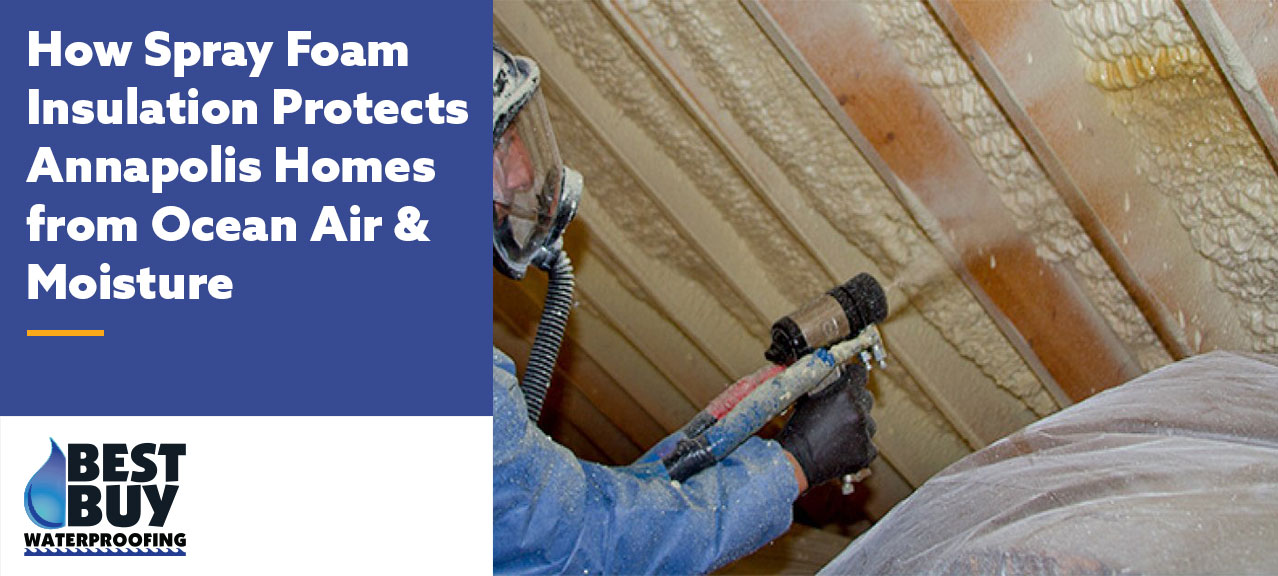
Application is precise work. High-pressure spray rigs mix the two chemical components right at the gun tip. Closed-cell foam goes on in one to two inches of thickness to reach the target R-value. Technicians spray evenly across studs and exterior sheathing, letting the foam expand and fill every gap as it cures. The surface becomes tack-free within minutes, but allow 24 hours before the space is back in use. Ideal application temperatures run between 60–80°F—temperature and humidity both affect how the foam sets.
Final inspection wraps everything up. Once the foam has fully cured, technicians verify coverage, check thickness, and confirm proper adhesion throughout. Any foam that extends past studs gets trimmed flush. You’ll receive documentation covering foam type, board feet installed, and achieved R-values—so you know exactly what was done and where.
How Best Buy Waterproofing Approaches Coastal Spray Foam Projects
Every Annapolis home is a little different. Salt air exposure, distance from the Severn River or Spa Creek, crawl space conditions, existing drainage—all of it affects how moisture moves through your specific property. That’s why we don’t start with spray foam. We start with a thorough assessment.
Our technicians look at what’s already in place—foundation drainage, prior moisture control measures, crawl space conditions—before recommending closed-cell spray foam applications. Homes near tidal waterways face sustained vapor pressure that a standard insulation upgrade simply won’t address on its own. We identify exactly where humid ocean air is getting in, and then we determine whether spray foam alone solves the problem or whether it works best alongside encapsulation and drainage corrections.
That’s the difference between a quick fix and a real solution.
Our approach integrates spray foam with the broader waterproofing work your home may need. The seamless application creates continuous barriers without weak points where moisture can sneak back in. The closed-cell structure we recommend blocks both air infiltration and vapor transmission in one installation—protecting your crawl spaces, rim joists, and basement walls from the inside out.
Ready to find out where coastal moisture is entering your home? Contact Best Buy Waterproofing for a spray foam insulation assessment tailored to your property’s specific moisture profile. No pressure—just answers.
Frequently Asked Questions
Does spray foam insulation block humidity, or just temperature changes?
Both. Closed-cell spray foam at 1.5 inches achieves moisture permeance below 1.0 perms—that qualifies it as a true vapor barrier, not just insulation. It stops water vapor transmission while delivering R-5.8 to R-6.9 per inch. Open-cell foam stays vapor-permeable and may need a separate vapor retarder on top of it.
Is closed-cell or open-cell spray foam better for a coastal home?
For Annapolis homes, closed-cell is the right call—especially in crawl spaces and rim joists where ground moisture and Chesapeake Bay humidity create constant pressure. It resists water absorption and carries FEMA approval as a flood-resistant material. Open-cell foam simply wasn’t built for that kind of sustained exposure.
Can spray foam alone fix a humid crawl space?
Spray foam handles air infiltration and vapor transmission well, but soil moisture is a separate problem. Pairing closed-cell foam with a ground vapor barrier addresses both sources. One without the other leaves part of the moisture cycle unresolved.
Does salt air affect how spray foam performs over time?
Cured polyurethane is chemically stable. Salt air corrodes untreated wood, metal fasteners, and ductwork—but it doesn’t degrade spray foam the same way. That’s one reason it holds up well in coastal applications where other materials wear down faster.
Where should spray foam be prioritized in an Annapolis home?
Start with rim joists, crawl spaces, and basement penetrations. These are the primary entry points for coastal moisture, and sealing them delivers the most noticeable improvement to both comfort and air quality.
Conclusion
Coastal living doesn’t give your home a break. The humidity, the salt air, the constant vapor pressure from the Severn River and Spa Creek—it all adds up faster than traditional insulation can handle.
Closed-cell spray foam gives Annapolis homeowners a real answer. It seals the gaps, blocks vapor transmission, and holds up in the crawl spaces, rim joists, and basement penetrations where coastal moisture does the most damage. Paired with proper drainage and encapsulation, it’s a system that keeps your home dry year-round.
We’re ready to take a look at your specific situation and show you exactly where coastal moisture is getting in.
Contact Best Buy Waterproofing today for a free spray foam assessment—and give your home and family the protection they deserve.