
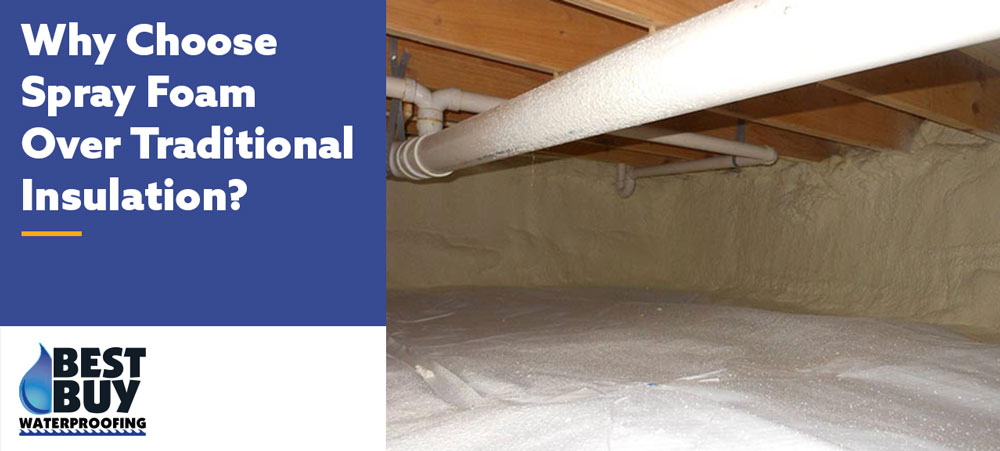
Skyrocketing utility bills, uncomfortable cold spots, and inconsistent temperatures often trace back to one issue: poor insulation performance. Many homeowners rely on traditional insulation like fiberglass or cellulose, but these materials typically deliver only 20–30% improvements in energy efficiency under real-world conditions.
At Best Buy Waterproofing, we help homeowners identify where energy loss is happening and how to fix it. One of the most effective upgrades is spray foam insulation, which can reduce energy costs by up to 50%. That level of performance comes from a combination of higher R-value, advanced air sealing, and long-term durability.
Understanding the difference between spray foam and traditional options can help you make a smarter, more cost‑effective investment in your home.
What Is R-Value and Why It Matters
What R-Value Measures
R-value measures how well insulation resists heat transfer. The higher the R-value, the better the material performs at keeping warm air inside during winter and blocking heat during summer.
However, R-value alone does not tell the full story. Real-world conditions like moisture, air leaks, and temperature fluctuations can significantly reduce how well insulation performs. This is where spray foam insulation has a clear advantage over traditional insulation.
Unlike fiberglass or cellulose, spray foam maintains its R-value more consistently over time, helping preserve long-term energy efficiency.
Spray Foam vs Fiberglass: Key Performance Differences
R-Value Comparison
Here’s how common insulation materials compare per inch:
- Closed cell spray foam insulation: R‑6.0 to R‑7.0
- Open-cell spray foam insulation: R‑3.5 to R‑4.0
- Fiberglass insulation: R‑2.2 to R‑3.2
- Cellulose insulation: R‑3.2 to R‑3.8
In spray foam vs fiberglass comparisons, spray foam insulation consistently delivers higher R-value per inch. This means better energy efficiency without needing as much material thickness.
Traditional insulation may appear more affordable initially, but achieving the same level of performance often requires more installation depth—and even then, results can decline over time.
Why Traditional Insulation Loses Performance
Traditional insulation naturally degrades through normal use and environmental exposure. Common issues include:
- Compression that reduces R-value
- Settling that creates gaps
- Moisture infiltration that weakens performance
- Air movement disrupting insulation layers
Fiberglass insulation, for example, can lose up to 50% of its effectiveness when compressed or exposed to moisture. This is why spray foam vs fiberglass is such an important comparison when looking at long-term performance.
By contrast, spray foam insulation resists compression and moisture, helping it maintain its effectiveness for decades.
Air Sealing: The Biggest Advantage of Spray Foam
Why Traditional Insulation Falls Short
Air leakage is responsible for up to 35% of heat loss in a home. Because traditional insulation is porous, it cannot fully stop airflow. Even well-installed materials leave gaps around seams, outlets, and structural penetrations.
This means conditioned air escapes while outside air enters, reducing overall energy efficiency.
How Spray Foam Insulation Creates a Seal
Spray foam insulation expands during application, filling cracks, gaps, and voids. This creates a continuous air sealing barrier throughout the space.
- Closed cell spray foam: effective at 1–1.5 inches
- Open-cell spray foam: effective at 3.5+ inches
This built-in air sealing is one of the biggest reasons why spray foam vs fiberglass comparisons show such dramatic performance differences. With fewer air leaks, your HVAC system runs more efficiently and maintains consistent indoor temperatures.
Eliminating Drafts and Improving Comfort
Air leaks commonly occur in attics, crawl spaces, rim joists, and wall cavities. These gaps lead to drafts, uneven temperatures, and uncomfortable living conditions.
Spray foam insulation expands into irregular spaces, sealing areas that traditional insulation cannot reach. As a result, homeowners experience:
- Improved indoor comfort
- Consistent temperatures throughout the home
- Reduced strain on HVAC systems
- Better overall energy efficiency
The difference is often noticeable immediately after installation.
Moisture Barrier and Mold Prevention Benefits
The Problem with Traditional Insulation
Traditional insulation does little to stop moisture intrusion. In fact, it can trap moisture, leading to several issues:
- Reduced R-value
- Increased risk of mold growth
- Damage to wood framing and drywall
Basements, crawl spaces, and attics are especially vulnerable to these problems.
How Spray Foam Insulation Protects Your Home
Closed cell spray foam acts as a moisture barrier, preventing water vapor from entering wall cavities.
It provides:
- Mold prevention by eliminating moisture buildup
- Protection against water intrusion
- Improved indoor air quality
Because spray foam insulation does not absorb water, it maintains its performance even in high-humidity environments.
Added Structural Strength
Closed cell spray foam offers an additional benefit that traditional insulation cannot: structural reinforcement.
Once cured, the rigid foam adds strength to walls and roof systems. Studies show that walls can become up to 300% stronger when insulated with closed cell spray foam.
This added durability helps protect your home from shifting, settling, and long-term wear.
Cost Comparison: Short-Term vs Long-Term Value
Upfront Investment
- Traditional insulation: $0.30–$1.80 per sq ft
- Open-cell spray foam insulation: $0.50–$1.50 per sq ft
- Closed cell spray foam insulation: $1.50–$4.50 per sq ft
While spray foam insulation requires a higher upfront investment, it delivers significantly better performance and longevity.
Energy Savings and ROI
Spray foam insulation can reduce energy costs by 30–50%, creating substantial long-term savings.
Example:
- $300 monthly energy bill
- 40% savings = $1,440 annually
- $14,400 saved over 10 years
Most homeowners recover installation costs within 3–5 years. Beyond that point, the savings continue, making spray foam insulation a highly cost-effective upgrade.
Long-Term Performance Comparison
Traditional insulation often needs to be replaced or upgraded due to:
- Settling and shifting
- Moisture damage
- Reduced effectiveness over time
Spray foam insulation, on the other hand, can last more than 30 years with minimal degradation. It maintains consistent energy efficiency without needing additional maintenance or replacement.
Open Cell vs Closed Cell Spray Foam
Open-Cell Spray Foam
- Lower upfront cost
- Ideal for interior applications
- Effective for air sealing
Closed Cell Spray Foam
- Higher R-value per inch
- Strong moisture barrier
- Adds structural strength
Closed cell spray foam is typically the better choice for basements, crawl spaces, and other moisture-prone areas.
Spray Foam vs Fiberglass: Final Verdict
When comparing spray foam vs fiberglass, spray foam consistently outperforms traditional insulation in key areas:
- Higher R-value
- Superior air sealing
- Better energy efficiency
- Strong moisture barrier
- Long-term durability
For homeowners looking to maximize comfort and savings, spray foam insulation is the clear winner.
Which Insulation Is Right for You?
If your goal is a lower upfront cost, traditional insulation may provide a short-term solution.
However, if you want long-term energy efficiency, better comfort, and lasting utility savings, spray foam insulation is the smarter investment.
At Best Buy Waterproofing, we evaluate each home’s unique needs and recommend solutions designed to deliver long-term results.
Final Takeaway
If your home has drafts, uneven temperatures, or rising energy bills, insulation performance is likely the problem.
Spray foam insulation improves energy efficiency, enhances air sealing, and provides durable, long-term protection that traditional insulation simply cannot match.
✅ Schedule a Free Inspection Today
Find out how much energy your home is losing and whether spray foam insulation is the right solution.
Contact Best Buy Waterproofing today for a free consultation and personalized recommendation.