
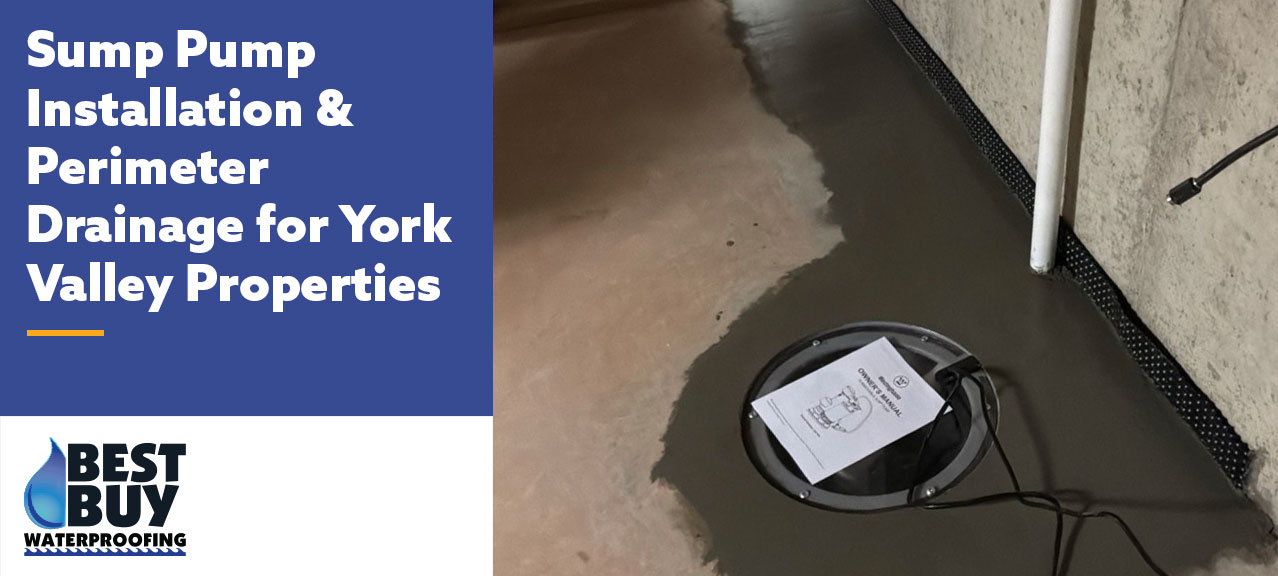
York County gets close to 48 inches of rain every year — well above the national average. When your home sits on clay soils in the Susquehanna Valley, that moisture doesn’t drain off quickly. It lingers near your foundation, builds hydrostatic pressure, and pushes groundwater through cracks and joints before you spot any sign of trouble. Homes outfitted with sump pump installation & perimeter drainage in York PA know how much water moves through their systems. Those experiencing damp basements will be surprised how effective this home upgrade performs.
That’s a real problem for a lot of homeowners here. Spring snowmelt makes it worse.
That’s exactly why basement waterproofing York PA homeowners rely on pairs an interior drainage system sump pump setup with a trusted perimeter drain system York County wide. A properly installed sump pump collects that groundwater and moves it safely away from your foundation. A battery backup sump pump keeps everything running during outages — right when you need it most.
Quick Answer: Why York Properties Need Both Systems Together
Sump pump installation & perimeter drainage York PA projects work because two things have to happen: water needs to be collected, and then it needs to go somewhere. Drainage handles the first job. The pump handles the second. A backup makes sure neither job stops when the power does. Here’s how each piece works for a York, Pennsylvania home.
How perimeter drains collect groundwater and sump pumps remove it
A perimeter drain system York County contractors install sits in a trench along your footing, collecting groundwater before it builds against the foundation. The perforated pipe, wrapped in a filter sock, channels that water through layered gravel toward a sump basin — where the pump lifts it out through a discharge line.
Neither half works alone. Drain tile with no pump has nowhere to send the water it collects. A pump without drain tile only catches what has already pooled on the floor. You need both.
How clay soils, seasonal rain, and freeze-thaw cycles affect York basements
York sits within the Piedmont, a fertile South Central Pennsylvania region rising toward the Blue Ridge Mountains, and many of its developments were built on moisture-retaining clay soils. That clay soil drainage York PA condition holds water near your foundation long after a storm passes. Then winter arrives, and freeze-thaw cycles widen small cracks each season, opening new paths for water to get inside.
It’s a slow process. But it adds up.
Groundwater pressure versus river flooding in the Susquehanna Valley
Hydrostatic pressure from a high water table builds gradually and can linger for weeks or months after rain stops — unlike surface runoff, which clears within hours. Susquehanna Valley flooding is a separate issue entirely. The river has overflowed its banks 14 times since 1810, roughly once every 15 years. Hurricane Agnes alone killed 72 people and caused $2.80 billion in damage across the basin in 1972.
Your basement faces both risks. Pressure building from below, and river-driven flooding from outside. Knowing that difference matters when you’re choosing the right protection.
Why older homes without drainage can overwhelm a sump pump
Building codes didn’t require perimeter drainage until relatively recently, so many older York homes were never built with one. Houses from before the 1970s often have no sub-floor drainage at all. Even where drain tile does exist, decades of sediment or iron ochre buildup can leave it crushed or completely clogged.
Installing a sump pump without addressing drainage doesn’t solve the problem. The pump only handles water that reaches the pit — everything else still seeps in through the cove joint.
Warning signs: floor-wall seepage, mineral stains, and pumps that cannot keep up
If your current setup is struggling, your basement will usually tell you. Watch for:
- Water seeping at the wall-floor cove joint, especially after storms
- White or gray mineral staining — called efflorescence — on basement walls
- A sump pump running continuously during wet seasons without cycling off
- Basement walls bowing inward, even slightly
Any one of these signals that hydrostatic pressure is outpacing your drainage. That’s exactly when a paired system earns its keep.
Choosing a Perimeter Drain and Sump Pump System
Getting the right sump pump installation perimeter drainage York PA setup starts with knowing what each component does — and how it fits your specific foundation. Best Buy Waterproofing goes through all of this during every basement waterproofing assessment across York County. No guesswork. Just a clear look at what your home actually needs.
What is a perimeter drain tile system?
Think of it as a collection channel built right into your foundation’s edge. A perimeter drain tile system is a perforated pipe laid in gravel along the interior or exterior of your footing, designed to intercept groundwater before it ever reaches your basement floor. Modern French drain installation York projects use PVC piping wrapped in filter fabric or a sock to keep sediment out while water flows freely through.
Interior vs. exterior drainage: why interior systems often suit existing homes
Exterior drainage sounds straightforward, but the reality is messier. It means digging up porches, walkways, and landscaping — then regrading everything as the backfilled soil settles over time. That’s a major disruption.
Interior drain tile sits above the footing in what’s called the “clear water zone.” It stays accessible for servicing and goes in without touching your yard. For most existing York homes, that’s the smarter path.
How sump basin placement and pump capacity affect water removal
Where the basin sits matters just as much as what pump goes inside it. Sump basin placement determines how efficiently water clears from your foundation. Pump capacity needs to account for vertical lift — the distance water travels from the basin to the discharge point — since manufacturers rate gallons-per-hour output differently at each lift height. A pump rated for one depth may perform very differently at yours.
Primary vs. backup sump pumps: protection during power outages
Your primary pump handles the day-to-day work. The backup steps in only when the main unit fails or the power goes out. Weather-related outages nearly doubled between 2014 and 2023 compared to the previous decade. That makes sump pump power outage protection a practical necessity, not a bonus feature.
Further reading: battery backup benefits and storm-pattern guidance
Want to know more about battery backup sump pump runtime and which battery types hold up longest? See why a battery backup is essential for every home and El Niño storm pattern guidance for a closer look at what York County storms can actually throw at your basement.
Sump Pump Installation and Perimeter Drainage: Step by Step
Knowing the right system is one thing. Seeing it installed correctly is another. Sump pump installation York PA projects follow a clear, proven sequence — and Best Buy Waterproofing walks every York County homeowner through each stage from start to finish.
1. Inspect water entry points, foundation condition, and local permit needs
A technician traces wall cracks, pipe penetrations, and cove joint seepage to pinpoint exactly where water is getting in. Block cores and footing condition get checked before any work begins, and any required local permits are pulled upfront.
2. Open the basement floor along the planned interior drain route
Crews break out an 18-inch strip of concrete along the perimeter walls to expose the footing, then dig a trench roughly 12 inches wide and 8 inches deep alongside it. Your yard stays untouched throughout.
3. Install drain tile and gravel with a path to the sump basin
A gravel bed cushions the perforated pipe, which runs the full loop toward the basin. Block foundations also get drilled weep holes so water trapped inside wall cavities can drain directly into the system.
4. Install the sump basin, primary pump, backup, and approved discharge route
The basin sits flush with the floor. Primary and backup pumps mount side by side or stacked, each with its own check valve. The discharge line runs at least 6 feet from your foundation to move water well clear of the structure.
5. Test water flow, pump controls, and backup operation
Before anything closes up, crews pour water into the basin, confirm the float triggers within 1-2 seconds, and simulate a power outage to verify your battery backup sump pump kicks in the way it should.
6. Restore the floor and walk you through operation and upkeep
Concrete goes back over polyethylene sheeting, and your installer reviews exactly how your interior drainage system sump pump setup works — and what routine maintenance keeps it running reliably for years ahead.
Every step is handled by our team, not subcontractors. You know who’s in your home and what they’re doing.
Maintaining Your System and Choosing a York Installer
Keeping your sump pump system ready doesn’t take much, but it does take consistency.
Test both pumps at least once a year, and run a quick water test before spring thaw and again before summer storm season. A dead backup battery won’t help you during a power outage. A fully charged battery backup sump pump typically gives you 10 to 12 hours of runtime when the power goes out, and that window matters.
Check your discharge lines regularly. Bury them below the frost line and make sure water exits at least 10 feet from your foundation. That prevents backflow and keeps lines from freezing up in the winter months.
Have your drain points inspected for sediment once a year. Debris and root intrusion build up slowly inside perimeter drain tile system piping, and gradual buildup is easy to miss until it becomes a real problem.
Wondering what installation costs? Pricing depends on your basement’s perimeter length, your foundation type, and the pump capacity you need. You’ll get a firm number after your inspection, backed by a transferable warranty.
Best Buy Waterproofing offers free field inspections across York County. We examine your interior walls, exterior grading, and downspout placement before recommending a sump pump installation perimeter drainage York PA solution sized to your specific home, not a one-size-fits-all fix.
Ready to get a clear answer with no pressure? Schedule your free basement waterproofing assessment in York, PA today.
Conclusion
York County basements face real pressure — from clay soils, freeze-thaw cycles, and Susquehanna Valley storms. But the right system handles all of it. Drainage collects the water, the pump removes it, and a battery backup keeps everything working when the power goes out.
That’s peace of mind your home and family deserve.
Best Buy Waterproofing offers free basement waterproofing assessments across York, PA — no pressure, just honest answers about what your foundation needs. Contact us today and let’s get your basement dry for good.