
Most Fairfax homeowners assume moisture is moisture — one problem, one fix. The reality is a little more complicated than that.
Basements here deal with two separate moisture threats, and each one requires a different defense. Clay-heavy soil, seasonal rain, and natural groundwater movement create conditions where liquid water can push through your foundation walls. At the same time, hot and humid Virginia summers send warm, moisture-laden air straight down into cooler underground spaces — leaving behind humidity that clings to walls, floors, and anything stored down there.
Here’s what most people don’t realize: a dehumidifier cannot stop water from seeping through your foundation. And basement waterproofing solutions Fairfax systems cannot pull excess humidity out of the air. These two systems solve two very different problems.
That’s exactly why controlling basement moisture Fairfax VA often takes both working together. We’ll walk you through what each system does, where each one falls short, and why your basement stays truly dry only when both threats are addressed.
Liquid Water vs. Water Vapor: Understanding the Fairfax County Problem
What Liquid Water Intrusion Actually Looks Like
Liquid water is the threat you can see. Water moves through foundation cracks, through the joint where your basement walls meet the floor, and straight through porous concrete when conditions are right. Basement moisture comes from three sources: liquid water from rain or groundwater, interior moisture sources, and exterior humid air.
Hydrostatic pressure is the biggest driver of liquid water problems in Fairfax. When the soil around your foundation gets saturated after heavy rain, rising groundwater pushes against your walls — and eventually finds its way through any crack or gap it can. Clay soil, which is common throughout Fairfax County, makes this worse. Unlike sandy soil that drains quickly, clay holds onto moisture for days after a storm — keeping that pressure against your foundation long after the rain stops.
Surface water adds to the problem too. Clogged gutters, short downspouts, settled pavement, and poor yard grading all push rainwater toward your foundation instead of away from it. A single 1-inch rain event drops roughly 1,250 gallons of water on a 2,000-square-foot roof. Without proper drainage in place, a significant amount of that water ends up in your basement.
The Invisible Threat: Water Vapor and Humidity
Water vapor is harder to catch. Unlike liquid water, it doesn’t flow through cracks — it moves through air and porous materials without any visible signs, right up until condensation forms on a cool surface.
Relative humidity tells you how much water vapor is in the air compared to what that air can hold at a given temperature. The EPA recommends keeping indoor humidity between 30–60% to prevent mold growth. Once basement humidity climbs past 60%, you’re creating the conditions mold, pests, and rot need to thrive.
Here’s how condensation happens: warm, humid outdoor air drifts into your cooler basement and contacts cold surfaces — walls, pipes, ductwork. Because basements stay naturally cool year-round (surrounded by earth on all sides), that temperature difference causes moisture to drop right out of the air onto those surfaces. The damp patches on your walls may look exactly like a seepage problem. But if the source is condensation, waterproofing alone won’t fix it.
Why Fairfax Gets Hit with Both
Fairfax County doesn’t get to pick just one moisture problem. Heavy seasonal rainfall saturates clay soil and builds hydrostatic pressure against foundations — that’s where basement waterproofing solutions Fairfax become essential for managing bulk water entry.
Then Virginia summers arrive. Hot, moisture-heavy air settles into cool basement spaces and creates persistent condensation — even in foundations with no cracks at all. Many homeowners crack open basement windows in summer thinking fresh air will help dry things out. It doesn’t. Humid outdoor air makes it worse.
Control basement moisture Fairfax VA strategies have to account for both. Liquid intrusion and ambient humidity are separate problems — and as we’ll cover next, they each need a different solution.
What Basement Waterproofing Does (And What It Can’t Do)
Basement waterproofing solutions Fairfax are built for one job: stopping liquid water from getting in. That’s it. Waterproofing won’t pull humidity from the air or dry out a damp basement. Knowing what it does — and what it doesn’t — helps you make the right call for your home.
How Waterproofing Stops Bulk Water Entry
There are two approaches: exterior and interior.
Exterior waterproofing goes after the problem at the source. Contractors excavate around your foundation, expose the walls, and apply waterproof membranes or coatings that block groundwater before it ever contacts your concrete. French drains or weeping tiles installed at footing level redirect water away from the structure entirely.
Interior waterproofing takes a different approach. Sealants and coatings applied to walls and floors slow moisture movement through concrete. Crack injection — using polyurethane or epoxy — seals the active leak points where water is already finding its way in.
Interior Drainage Systems and Sump Pumps
For many Fairfax homeowners, an interior drainage system paired with a sump pump is the most practical solution.
Perimeter drainage channels run along the wall-floor joint — the most common entry point for water. Water flows through those channels into a sump pit at the lowest point of the basement. When water reaches a preset level, the sump pump kicks on automatically and pushes it out through discharge pipes away from your foundation.
One thing worth knowing: well-designed systems sit on top of the footing rather than in the mud below, which significantly reduces clogging over time. A wall flange along the channel accepts seepage coming down the wall while keeping floor debris out of the drainage path.
Crack Repair and Hydrostatic Pressure Relief
Foundation cracks are direct entry points for water. Polyurethane foam injection expands on contact with moisture, filling the crack and creating an impermeable seal. Where structural integrity is a concern, epoxy resin injections go a step further — restoring wall strength while closing the crack.
Hydrostatic pressure relief valves release excess groundwater pressure that builds against your foundation during saturated soil conditions.
What Waterproofing Cannot Fix
Here’s the honest answer: waterproofing will not solve a humidity problem.
Drainage channels move liquid water out. They can’t pull moisture from the air or stop condensation from forming on cool walls, pipes, or ductwork. When warm summer air settles into a cool basement, condensation happens — with or without a crack in sight, and with or without a waterproofing system in place.
That’s where a dehumidifier comes in. Two separate problems. Two separate solutions.
What Dehumidifiers Do (And What They Can’t Do)
So if waterproofing handles liquid water, what handles the humidity? That’s where a dehumidifier comes in.
How Dehumidifiers Control Basement Humidity
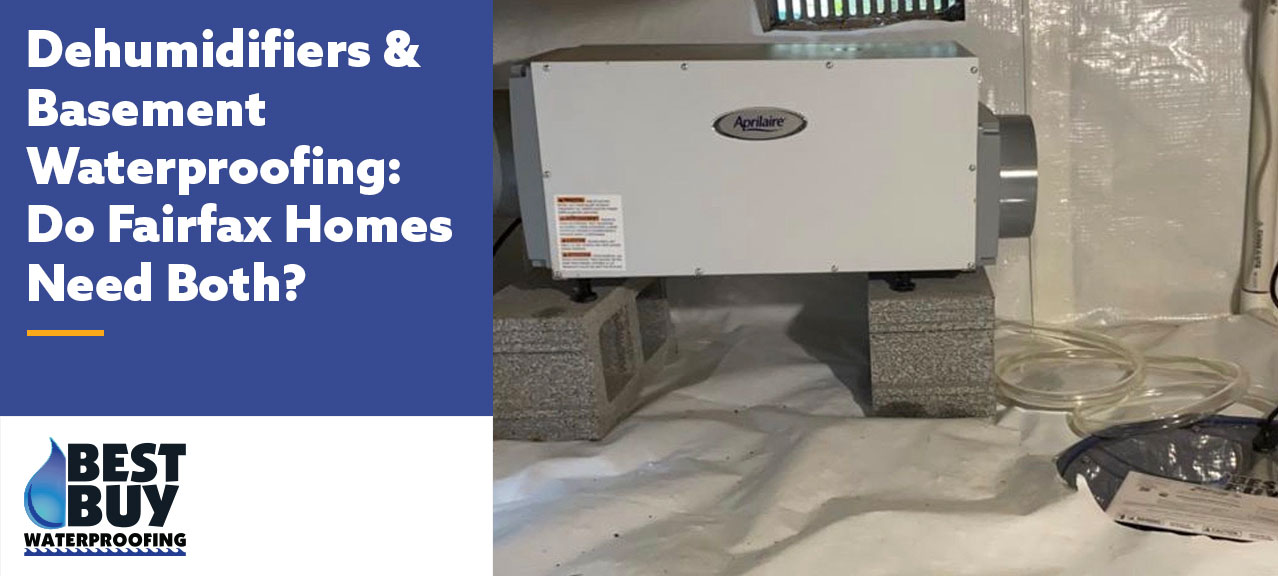
A dehumidifier works by pulling humid basement air over refrigerated coils cooled below the dew point. Moisture condenses out of the air and collects as liquid water, which drains away automatically or gets collected in a reservoir. The result is drier air — and drier air allows damp materials in your basement to continue releasing moisture over time.
For basement dehumidifiers Fairfax County, the target range is 45–55% relative humidity. Keeping humidity below 60% cuts off the conditions mold needs to grow, while staying around 50% prevents musty odors without drying out wood framing or structural beams.
Not all units are built the same, either. Commercial-grade systems remove up to 100 pints of moisture per day and include automatic drainage so you’re never emptying a tank. Consumer models typically handle 30–50 pints and need more hands-on attention.
Benefits of Maintaining Proper Relative Humidity
Getting humidity under control does more than just prevent that musty smell. Here’s what proper humidity levels actually protect:
- Mold prevention — mold colonizes once humidity climbs past 60%
- Structural protection — beams, floor joists, and stored belongings stay safe from rot and deterioration
- Lower energy bills — your HVAC system runs shorter cycles when it isn’t fighting humid air
- Whole-home air quality — basement air rises through your home naturally, so a drier basement means cleaner air upstairs
Protecting your home and saving energy — a dehumidifier delivers both when it’s sized and installed correctly.
Limitations of Dehumidifiers Against Water Intrusion
Here’s the hard truth: a dehumidifier is not a waterproofing solution. If water is actively coming through foundation cracks, a failed drainage system, or a plumbing leak, no dehumidifier can keep up. These units manage ambient moisture in the air — they don’t have the capacity to handle bulk water intrusion.
A common question we hear is, do I need a dehumidifier after basement waterproofing? The answer is often yes — but the order matters. Get the liquid water under control first. Then a dehumidifier handles the humidity that remains.
Why Fairfax Homes Benefit from Both Systems
Preventing the Stack Effect in Your Home
Warm air naturally rises through your home. When it escapes through upper levels, it creates negative pressure in the basement — and that vacuum pulls outdoor air in through foundation openings. In the summer, that means humid air flooding your basement. In the winter, cold drafts.
Waterproofing seals the points where liquid water gets in. Dehumidifiers handle the humidity that rides in on that air exchange. One system without the other leaves half the problem unsolved.
Stopping Mold Growth Even Without Standing Water
Here’s something that surprises a lot of homeowners: you don’t need standing water for mold to grow.
Once humidity climbs past 60%, mold spores can settle on wood framing, drywall, and stored belongings — no puddles required. Waterproofing takes care of bulk water after a storm. But between rain events, it’s the ambient humidity that keeps feeding the problem. That’s where a dehumidifier earns its place.
Protecting Your HVAC System and Energy Costs
A damp basement makes your whole HVAC system work harder. Moisture raises indoor temperatures, creates clammy air, and pushes your system into longer cooling cycles. Over time, that means higher electric bills and equipment that wears out faster.
Running both systems together takes that strain off your HVAC — and you’ll feel the difference in your energy costs.
Retail Dehumidifiers vs. Commercial-Grade Systems
Not all dehumidifiers are built for basement work. Here’s a quick comparison:
- Commercial units remove 100–300 pints of moisture daily, include automatic drainage, and are built with steel construction for durability in tough basement environments.
- Retail models handle 20–70 pints, require manual tank emptying, and use lightweight plastic housing.
For a Fairfax basement dealing with persistent humidity through hot Mid-Atlantic summers, a commercial-grade unit is worth the investment. A retail dehumidifier will run constantly and still struggle to keep up.
Schedule Your Fairfax Basement Waterproofing Estimate
Liquid water and water vapor are two different problems. They need two different solutions.
Waterproofing keeps bulk water out — the kind driven by Fairfax’s clay soil, heavy rain, and groundwater pressure pushing against your foundation. A dehumidifier handles what waterproofing can’t — pulling excess humidity from the air before it settles on surfaces and creates the conditions mold needs to grow.
Used together, dehumidifiers and basement waterproofing Fairfax VA aren’t competing investments. They’re complementary ones. Each system does its job, and your basement stays dry because nothing slips through the gap between them.
If you’re not sure which problem you’re dealing with — or if you suspect it might be both — that’s exactly where we can help. Reach out today for a free inspection, and we’ll take an honest look at what’s going on down there.