
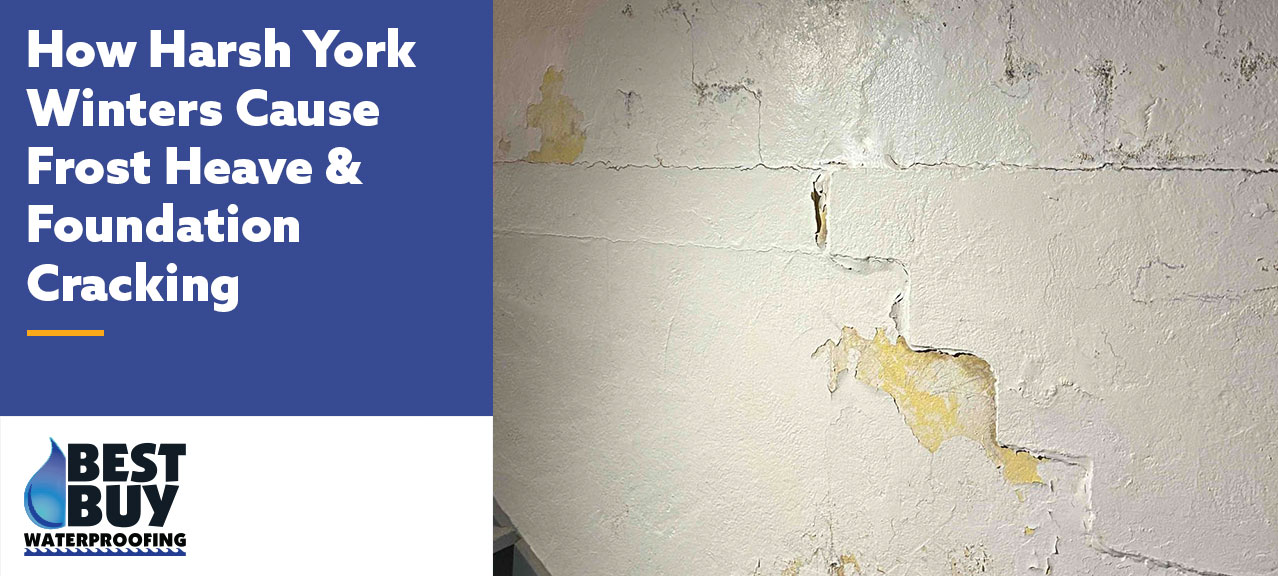
York winters are hard on foundations. If your home sits near Codorus Creek or in one of the region’s newer clay-soil neighborhoods, frost heave foundation cracking is something you need to take seriously. Frozen ground expands by nearly 10%, and that pressure is enough to shift slabs and crack foundation walls. Frost heave isn’t a minor seasonal inconvenience—it has caused billions of dollars in infrastructure damage across the country, and your foundation faces the same forces every single freeze-thaw cycle.
York PA winter foundation damage rarely announces itself all at once. It starts quietly—a hairline crack here, a door that sticks there. Left alone, those small signs grow. Clay soil freeze-thaw conditions common across York accelerate the problem, leading to bowing walls, uneven floors, and mounting hydrostatic pressure beneath your home.
The good news? Catching the warning signs early makes a real difference. Understanding what causes frost heave is the first step—before foundation repair or York basement waterproofing becomes urgent.
What Actually Causes Frost Heave in York?
Frost heave starts well below the surface—long before a crack shows up on your basement wall. Here’s what’s happening underground, and why York’s geology makes the problem worse than most homeowners expect.
What Is Frost Heave? Freezing Soil and Growing Ice Lenses
Think of frost heave as a slow, invisible force building beneath your home all winter. When soil freezes, it pulls groundwater upward and forms what engineers call ice lenses—layers of pure ice that grow within moist, frozen soil and push against whatever sits above them. Three things have to line up for this to happen: temperatures cold enough to freeze deep into the ground, a steady water supply, and the right kind of soil sitting in that freeze zone.
Water expands roughly 9% in volume when it freezes, and that water doesn’t have to be sitting right under your foundation. It can migrate through soil toward a growing ice lens from as far as 20 feet away. Cold temperatures, moisture, and frost-susceptible soil—those three working together beneath your foundation is what causes frost heave.
Why Clay Soil Makes Things Worse
Clay soil is a big part of why York homeowners deal with this more than they should. Clay holds water well, but it drains slowly. During a freeze, water moves through it at a crawl—and that slow movement still produces heave, even if it’s less sudden than what you’d see in silt. Under standard engineering classifications, clay falls squarely in the frost-susceptible category, meaning homes built on heavier clay carry a higher baseline risk of heaving soil foundation damage every single winter. The more absorbent the soil beneath your home, the more frost heave your foundation absorbs year after year.
Near Codorus Creek and in Newer Developments
Soil and drainage conditions aren’t the same everywhere in York County. Near Codorus Creek—a waterway that drains more than 278 square miles across southern York County—older homes sit close to groundwater sources that feed frost heave from below. Historic brick structures along the creek have been dealing with this cycle for generations.
Newer developments tell a different story. Much of that ground was disturbed and recompacted during construction, which changes how water moves through it. The result is moisture-retaining clay that keeps the freezing front well-supplied all winter long.
York’s Freeze-Thaw Cycle Is the Real Culprit
York doesn’t freeze hard once and stay that way. Temperatures swing above and below 32°F repeatedly through the season, and every crossing of that threshold restarts the expansion-and-contraction cycle underground. PennDOT sees this same pattern in roads every year—”freezing one minute to a warmer temperature the next” tears pavement apart. The soil beneath your foundation works the same way.
That’s how York PA winter foundation damage compounds—one freeze-thaw cycle at a time. Pennsylvania’s frost line depth means footings need to sit well below grade to avoid the worst of it. When they don’t, the ground underneath a home takes the full brunt of every swing in temperature.
What Frost Heave Does to a Foundation Over Time
Winter doesn’t crack a foundation in one night. The damage builds season after season, one freeze-thaw cycle at a time, and each stage leaves its own mark on a York home.
How uneven lifting puts stress on footings, slabs, and walls
Ice lenses don’t form evenly beneath a foundation—they develop in pockets where moisture concentrates. That means the lifting isn’t uniform either. One corner of a slab can rise while the rest stays put. During a hard freeze, expanding soil can push thousands of pounds of pressure against walls and slabs. Footings shift. Posts and columns lose the support they were set to carry. That kind of uneven movement puts stress on every connected part of the structure above it.
Why thawing soil can leave uneven support beneath a home
Here’s what most homeowners don’t realize: when temperatures climb back above freezing, the soil doesn’t simply return to where it started. It sloughs into the gaps left behind by shifting components. What was once solid ground ends up loosened, weak, or missing altogether in spots where it used to hold firm. Each cycle leaves the foundation sitting on slightly less support than before.
How repeated winters can compound damage in older foundations
Older York homes with shallow footings feel this the most. Foundations built before modern construction standards weren’t designed with today’s understanding of frost depth and soil behavior. Every winter, existing micro-cracks widen just a little more—letting in more water, which freezes, which widens the crack further. The damage compounds quietly, year over year. Left unaddressed, this repeated “jacking” effect can eventually cause the supporting components themselves to fail.
How hydrostatic pressure adds stress to basement walls
Frost heave isn’t the only force at work. As frozen groundwater builds up around a foundation, it creates hydrostatic pressure that pushes directly against basement walls. Add in the roughly 9% volume expansion of freezing water, and that pressure becomes relentless. It’s a combination that sets the stage for the cracks and bowing we’ll look at next.
Signs of Frost Heave Damage in a York Home
Winter leaves clues. Knowing what to look for on your foundation can be the difference between a simple repair and a costly one.
Foundation Cracks That Appear or Widen After Winter
Pay attention to cracks that show up—or grow—right after a cold snap. That timing points to frost heave, not just normal wear. Horizontal cracks deserve extra attention, since they signal lateral soil pressure pushing against your wall. Once a crack hits roughly 1/4 inch wide, or you notice one side sitting higher than the other, you’re past cosmetic territory and into something structural.
Doors and Windows That Stick During Cold Weather
Most homeowners notice this one first. A door that binds or won’t latch only when it’s cold outside isn’t a coincidence—frost heave is pushing against the frame from below, shifting how it fits in the opening. If it frees up once the ground thaws, that’s a pattern worth tracking.
Uneven Floors and Gaps Along Basement Walls
Floors that slope or feel spongy underfoot are worth investigating. When soil lifts unevenly beneath a slab, the slab can pull away from the surrounding wall—opening a gap that lets water in and widens a little more with every freeze.
Bowing Walls and Water Coming Through Cracks
Any inward bowing of a basement wall is serious. Movement beyond 1/2 inch means the pressure behind that wall is significant. Bowed walls crack, and once they do, hydrostatic pressure has a direct path to push water through.
Frost Heave vs. Ordinary Settlement—How to Tell the Difference
Here’s a simple way to tell them apart. Frost heave damage tends to worsen each winter and ease up once the ground thaws. Ordinary settlement keeps moving regardless of the season. If your symptoms follow the cold, frost heave is likely the cause.
When to Stop Waiting and Call for a Structural Inspection
Some things shouldn’t be left to monitor season after season. A crack that keeps widening, a wall bowing more than an inch over an 8-foot span, or multiple doors sticking at the same time—these aren’t signs to watch [172]. They’re signs to act on. A structural inspection will tell you exactly what you’re dealing with and what needs to happen next.
Repairing Frost Heave Damage and Reducing Future Risk
Getting frost heave foundation cracking fixed the right way means addressing the actual cause—not just filling in what’s visible on the surface.
Steel piers or foundation underpinning are the right call once footings have shifted or settled unevenly. Piers transfer the load below the active freeze zone, stopping the cycle of recurring movement. Foundation crack injection seals the leak, but if a crack shows displacement, structural repair comes first. Urethane flexes with a shifting wall; rigid epoxy can re-crack under renewed pressure.
On the drainage side, grading and downspout extensions do more than most homeowners expect. A 5% slope away from the foundation over ten feet—combined with extensions that carry runoff well clear of the wall—keeps water from feeding ice lenses through the winter. Footing insulation isn’t one-size-fits-all either. Code-compliant shallow footings can work at as little as 16 inches when paired with the right insulation values for your local freezing index.
Pairing structural repair with basement waterproofing in York, PA tackles both the lift and the leak—typically through interior drainage systems and sealed cracks working together.
Best Buy Waterproofing can assess seasonal damage before winter sets in, catching heaving soil foundation damage while repairs are still straightforward. The sooner you call, the simpler the fix.
Don’t Wait on Frost Heave Damage
Frost heave foundation cracking doesn’t pause between winters. Each freeze-thaw cycle picks up right where the last one left off—widening cracks, shifting footings, and adding pressure to already-stressed basement walls.
Sticking doors, hairline cracks, uneven floors—these aren’t things to watch and wait on. They’re your foundation telling you something’s wrong. Catching it early keeps the repair straightforward. Waiting makes it costly.
Best Buy Waterproofing is here to help York PA homeowners get ahead of winter damage—before it gets worse. From foundation underpinning and crack injection to full basement waterproofing, we’ll assess what’s happening and give you real answers, not a sales pitch.
Contact Best Buy Waterproofing today for a free inspection.