
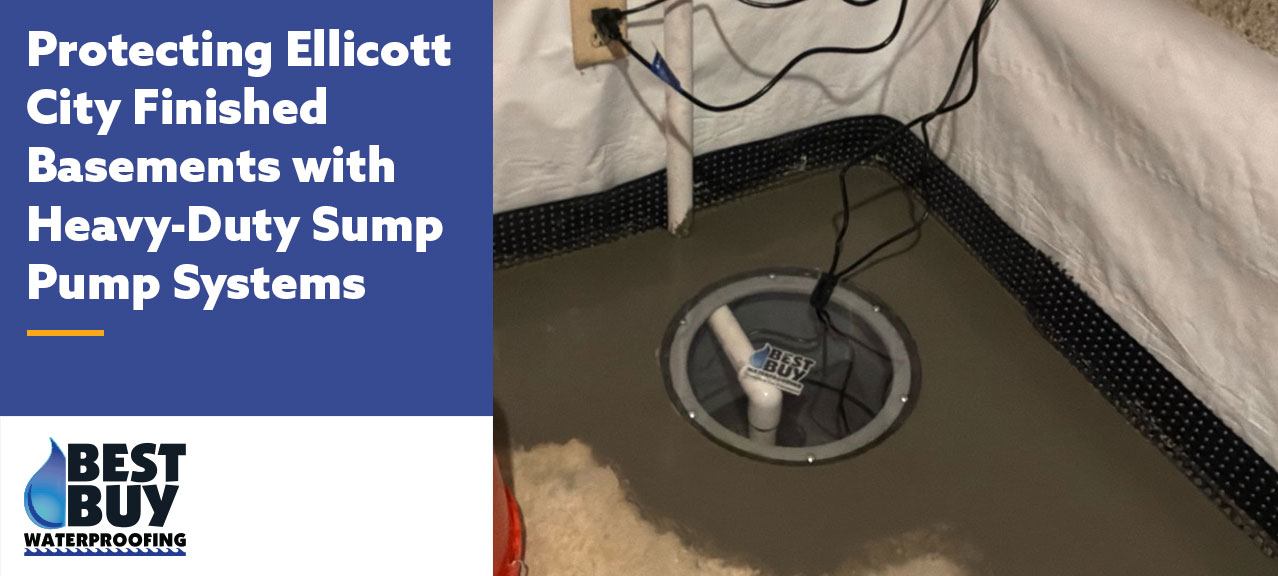
Finished basements in Ellicott City carry a real risk that too many homeowners find out about the hard way. A single flooding event can cost upward of $5,000 to clean up — and that’s before you factor in the ruined drywall, soaked flooring, and damaged furnishings that standard sump pump systems simply aren’t built to protect.
Ellicott City isn’t a typical flood-risk area. Its flash flood history and hilly terrain create conditions that overwhelm basic equipment fast. When water moves that quickly and in that volume, you need more than a standard pump.
That’s where heavy-duty sump pump installation comes in — paired with a battery backup sump pump Ellicott City homeowners can count on when storms knock out power. Together, they provide the capacity and redundancy your finished space actually needs.
Best Buy Waterproofing is here to help you understand where standard systems fall short and what the right setup looks like for a home in this area. Your investment in that finished space deserves real protection — not just the minimum.
Why Ellicott City Finished Basements Need Heavy-Duty Sump Protection
Ellicott City’s Hilly Terrain and Flash Flood History
Most basement flooding builds gradually. Ellicott City doesn’t work that way.
The town sits in a valley where three tributaries — Tiber Branch, Hudson Branch, and New Cut Branch — funnel stormwater directly toward residential areas every time heavy rain hits. Water doesn’t rise from below. It cascades down from the hillsides above, and it moves fast.
The numbers tell the story. The 2016 flash flood dropped 6.60 inches of rain in just two hours, sending the Patapsco River up more than 13 feet in 100 minutes. The 2018 event was worse — 9.71 inches of rainfall, nearly double what fell two years earlier. Both floods overwhelmed standard drainage systems before most homeowners could react.
Sump pump systems Ellicott City homeowners install need to handle that kind of rapid water accumulation. Standard equipment isn’t rated for it.
What Makes a Sump Pump Heavy-Duty: Horsepower and GPH Capacity
Two specs determine whether a pump is truly heavy-duty: horsepower rating and gallons-per-hour capacity at real lift heights — not the zero-lift numbers listed on the box.
Standard residential pumps run between 1/4 and 1/3 HP. Heavy-duty models start at 1/2 HP. At 10 feet of vertical lift, a 1/2 HP pump moves 3,000 to 4,000 GPH — roughly 35 to 40% more water than a 1/3 HP unit. Homes with deep basements or elevated water tables often need 3/4 HP pumps capable of moving up to 5,000 GPH.
Construction material matters too. Cast iron housings dissipate heat more effectively than thermoplastic models, which means longer operational life during extended pumping — exactly the kind of situation Ellicott City storms create.
Standard vs. Heavy-Duty: How the Numbers Compare
A standard 1/3 HP pump moves around 2,000 GPH and handles 7 to 10 feet of vertical lift. A 1/2 HP heavy-duty unit stretches that to 15 feet of lift, handling significantly more water in the same amount of time.
For homes in low-lying areas or floodplains, 3/4 to 1 HP pumps are worth serious consideration. They provide 20 to 30 feet of lift and can accommodate horizontal discharge runs of 150 to 200 feet.
There’s also a durability difference. Heavy-duty pumps use continuous-duty motors built to run for extended periods without overheating. Standard models use intermittent-duty motors that cycle in short bursts — fine for a light rain, not built for a flash flood.
Why Finished Basements Have More at Stake
Unfinished concrete takes on water and dries out. Finished spaces don’t recover that easily.
Drywall soaks up moisture fast. Laminate flooring warps. Carpeting traps water beneath the surface. What might be a manageable cleanup in an unfinished space becomes a full gut-and-replace job when finished materials are involved. And most standard homeowners insurance policies won’t cover it — flood damage is typically excluded, and sewer backup coverage requires a separate policy.
A sump pump failure during a power outage can wipe out thousands of dollars in finished materials in a matter of hours. A battery backup sump pump Ellicott City system keeps water moving out of that pit even when the power goes down — protecting everything you’ve put into that space.
Battery Backup Systems and Dual Pump Protection
Why battery backup isn’t optional during power outages
Here’s something most homeowners don’t realize until it’s too late — power outages are the number one cause of sump pump failures, not mechanical breakdowns. Think about what happens during a major storm. The same system that saturates the ground and fills your sump pit is the same system that knocks out your electricity. Your primary pump goes silent right when you need it most.
A battery backup sump pump Ellicott City system changes that equation. When AC power fails, it kicks in automatically, drawing from a deep-cycle battery that provides 7 to 8 hours of active pumping time. Most residential units handle 2,000 to 5,000 gallons on a single charge, while heavy-duty battery backups move 3,000+ gallons per hour. And the cost? Battery backup installation runs $300 to $600 — a fraction of the $4,500 to $8,000 average basement flood remediation expense. That’s a straightforward comparison.
Dual sump pump systems for redundancy
Two electrical pumps might sound like double the protection. It isn’t. If the power goes out, both units go down at the same time — you’re no better off than with one.
A true dual sump pump system pairs a high-capacity primary pump with a battery-powered secondary unit in the same pit. That combination eliminates single-point failure and keeps water moving even when one pump fails or gets overwhelmed. It also shares the workload during extreme events, which extends equipment life and adds capacity exactly when you need it most.
Basement flood alarm systems as early warning
Even the best pump system benefits from an extra set of eyes. Water alarms detect rising water and send sound alerts, digital messages, or visual indicators the moment flooding begins. Battery-powered sensors keep running through power outages, and cellular-based models bypass Wi-Fi entirely — so you get real-time notifications even when internet service is down.
Position alarms near your sump pump and along foundation walls for layered coverage. Smart models push alerts to your phone when you’re away from home, giving a neighbor or plumber time to respond before damage gets out of hand.
Signs your current sump pump isn’t enough
Your pump will usually tell you something’s wrong before it fails. Watch for:
- A pump running almost constantly during normal rainstorms — that means it’s already near capacity with no reserve left for a heavier event
- Frozen or crushed discharge lines pushing water back into the pit and forcing your pump into a losing cycle
- Frequent cycling, excessive noise, or non-stop operation — all signs of undersized capacity or wear
If you’re noticing any of these, it’s worth having someone take a look before the next storm rolls through.
Protecting Finished Basement Materials and Layout
How Drainage Design Protects Flooring and Drywall
Water doesn’t announce itself before it ruins your flooring or soaks into your drywall. That’s what makes finished basements especially vulnerable — moisture hides behind walls and under carpeting until the damage is already done.
Interior drainage systems stop that from happening. A perimeter drain installation collects water right at the wall-floor joint and channels it directly to the sump pit. Wall flanges capture seepage from foundation walls and guide moisture into drainage channels before it ever reaches your drywall. Think of it as intercepting the problem at the source, rather than cleaning up afterward.
Water stains and mold growth are usually signs that infiltration has been happening for a while. A proper interior drainage setup would have caught it first.
Moisture-Resistant Materials Near Floor Level
The materials you choose near floor level make a real difference. A few worth knowing:
- PVC wall panels resist liquid water and inhibit mold growth — a better option than untreated finishes in any area close to the floor
- Waterproof masonry paint seals concrete walls and cuts down on vapor transmission
- Vapor barriers beneath flooring block moisture from rising through concrete slabs
Skipping that vapor barrier isn’t just a risk — it voids many flooring warranties outright. It’s a small step that protects a big investment.
Planning Sump Capacity Around Your Finished Space
Placement matters as much as pump size. A sump pit positioned at the basement’s lowest point lets gravity do the work, pulling water toward the basin rather than across your finished floor. Pumps along exterior walls keep discharge runs shorter and reduce the chance of freeze damage in colder months.
Proper basin sizing matters too. An undersized basin forces your pump to cycle constantly, wearing it down long before its time.
French Drain and Sump Pump Pairing
A sump pump works best when it’s not working alone. Pairing it with a French drain gives your finished basement a full line of defense.
Perforated pipe surrounded by washed stone captures groundwater and delivers it straight to the sump basin. Interior perimeter systems along basement edges intercept water before it ever reaches your living area. Clean gravel backfill around the sump liner keeps silt from building up and slowing things down.
Together, these systems handle what no single component could manage on its own.
Installation, Maintenance, and System Assessment
Professional Assessment of Water Volume Risk
Not every home needs the same pump. That’s why professional consultation matters — especially if your current pump fails repeatedly, you’re in the middle of finishing your basement, or your home sits in a recognized flood zone.
A qualified inspector evaluates drainage patterns, water entry points, and soil conditions to calculate how much water your home actually accumulates during a storm. The most reliable way to measure peak inflow is simple: time how quickly water rises in the pit during heavy rain, or count pump cycles per minute. Multiply gallons per minute by 60, and you have your required GPH capacity.
That number drives every equipment decision after it.
Selecting the Right Pump Capacity and Housing
Once you know your peak inflow rate, choose a pump that delivers at least 1.5 times that volume at your actual head height. This detail matters more than most homeowners realize.
A pump rated at 2,400 GPH at zero lift may only deliver 1,500 GPH once water is pushed up 10 feet of vertical rise. Always check rated performance at realistic lift heights — not just the number on the label.
For housing, cast iron is the right call for continuous operation. It handles heat better and holds up longer than thermoplastic models, which is exactly what you need during extended storm events.
Installing the Primary Pump with Battery Backup
Before anything goes into the pit, inspect all electrical connections and clear out any debris. Then:
- Connect the discharge pipe securely and verify the check valve is oriented correctly to prevent backflow
- Mount your battery backup unit within 4 feet of the primary pump using the provided cables
- Once everything is connected, fill the pit with water to test both pumps — then unplug the primary to confirm the backup activates on its own
That last step is critical. Don’t assume the backup works. Test it.
Regular Testing and Discharge Line Maintenance
Monthly maintenance doesn’t take long, but skipping it does. Once a month, pour water into the pit or manually lift the float switch to confirm the pump activates. While you’re at it:
- Clear any mud, silt, or debris that has settled in the basin
- Clean the anti-airlock hole, float switch, and impeller
- Check discharge lines for blockages or any freeze damage from the previous season
Small maintenance habits prevent the big failures.
Annual Inspection Schedule for Flood-Prone Areas
For homes in flood-prone areas like Ellicott City, once-a-year inspections aren’t enough. Schedule professional inspections twice yearly — spring before heavy rain season and fall before the first freeze.
Each inspection should cover:
- Visual checks for rust and corrosion on pump components
- Float switch testing and pump performance evaluation
- Discharge line verification
Also, replace deep-cycle batteries every 3 to 5 years. A battery that’s past its service life won’t carry your backup pump through a long storm — and that’s exactly when you need it most.
Best Buy Waterproofing can walk you through the full assessment process and make sure your system is ready before the next storm rolls in.
Conclusion
Your finished basement represents a real investment — in your home, your family’s comfort, and your property’s value. Standard sump pump systems weren’t built for what Ellicott City storms can deliver. When the next heavy rain hits, you need equipment that can keep up.
Heavy-duty pumps paired with a battery backup sump pump Ellicott City system give you the capacity and peace of mind that basic setups simply can’t match. And when the power goes out mid-storm, you’ll be glad you planned ahead.
Best Buy Waterproofing is ready to help you find the right system for your home — one that fits your basement, your budget, and the real flood risks in this area. Don’t wait until water is already on your floor to find out your current setup wasn’t enough.
Contact Best Buy Waterproofing today for a free inspection. We’ll take a look, give you straight answers, and help you protect what you’ve worked hard to build.