
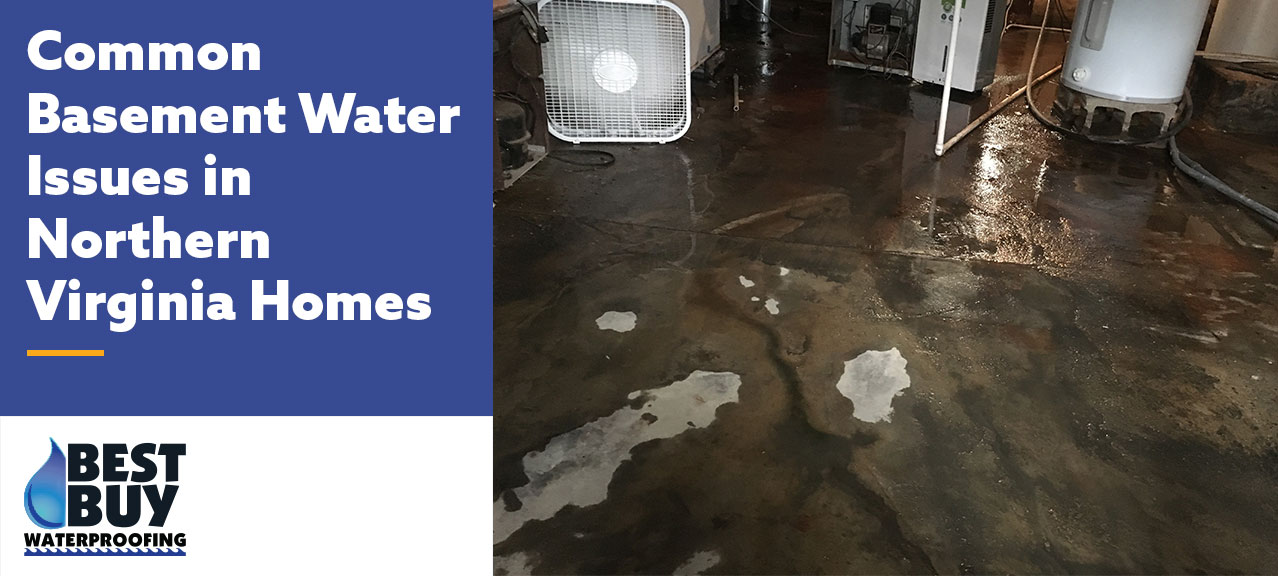
Your basement tells you a lot about your home’s health — and in Northern Virginia, it often tells you there’s a problem.
Between the region’s dense development, aging infrastructure, and clay-rich soils, basement water issues here are more common than most homeowners expect. The area’s expansive marine clay holds massive amounts of water after seasonal rainstorms. That trapped moisture creates intense hydrostatic pressure, forcing water through basement wall cracks, floor slabs, and cove joints.
Homeowners across Alexandria and Fairfax deal with everything from sump pump failures to white, chalky efflorescence creeping across basement walls. These aren’t random occurrences — they’re the predictable result of conditions specific to this region.
The good news? Solutions exist. Interior drainage systems, battery backup sump pumps, and targeted basement waterproofing address these recurring challenges effectively.
This guide breaks down why your basement leaks, what happens if you ignore it, and what professional waterproofing looks like for Northern Virginia homes.
Why Northern Virginia Basements Are Prone to Water Problems
Most basement water problems don’t happen randomly. There are real geological and environmental reasons why homes throughout Fairfax, Alexandria, Loudoun, and Arlington counties deal with moisture year after year. Once you understand what’s working against your foundation, the solutions make a lot more sense.
Expansive Marine Clay Soil and Foundation Pressure
The ground beneath much of Northern Virginia is made up of what geologists call the Potomac Formation — locally known as marine clay. This clay-rich sediment contains minerals that absorb water easily and expand significantly when saturated. Unlike sandy soil, which drains quickly, clay holds moisture long after a storm has passed.
Here’s what that means for your foundation. When clay absorbs water, it swells and pushes hard against basement walls. Engineers call this lateral pressure — it works horizontally, and it’s relentless. Then, when things dry out, the clay shrinks and leaves voids around your foundation, causing uneven settling. That cycle — swelling, shrinking, swelling again — repeats every year and slowly weakens structural integrity.
Marine clay is concentrated east of I-95, covering areas including Arlington, Alexandria, Fairfax, and Prince William counties. The Potomac Formation can reach over 100 feet deep along the eastern boundary of Fairfax County alone. Fairfax County officially classifies these soils as Class III problem soils because of their high shrink/swell potential and low bearing strength. That’s not a minor designation — it’s a signal that the ground itself creates ongoing challenges for any structure sitting on it.
Hydrostatic Pressure from Groundwater
Water weighs slightly more than 60 lbs. per cubic foot. When the soil around your basement becomes saturated after heavy rain, the pressure building against your foundation walls adds up fast — we’re talking tens of thousands of pounds. During storm season, that number can exceed 100,000 pounds of continuous pressure pressing against your concrete.
Concrete isn’t perfectly solid. As it cures, it dries unevenly and develops microscopic openings. Hydrostatic pressure finds those openings. The cove joint — where your basement floor meets the wall — is another inherent weak point. Water doesn’t need a big crack to get through. It just needs a way in.
Seasonal Weather Patterns in the DMV Region
Northern Virginia gets roughly 43 inches of precipitation each year. Summer thunderstorms are the real challenge — July and August storms can drop an inch or two of rain in under an hour, far faster than the ground can absorb it. A single inch of rain on a 2,000-square-foot roof sends over 1,200 gallons of water straight toward your foundation.
Late summer and early fall bring another threat. Tropical storm remnants push through Virginia and dump prolonged, soaking rain on ground that’s already saturated. The July 2019 storm that stalled over the D.C. region is a good example — more than three inches fell in about an hour, triggering flash flood emergencies from Arlington to Reston.
Poor Exterior Drainage and Grading Issues
When a home is built, contractors excavate around the foundation and then backfill that space with loose soil. That loose backfill settles over time and tends to create depressions right next to the house — essentially funneling water toward the foundation instead of away from it. The standard recommendation is for ground to slope at least six inches away from the house over the first ten feet.
Downspouts that discharge too close to foundation walls make things worse. Clogged gutters cause water to overflow and pool near the base of the house. And because clay soil is so impermeable, water backs up on top of it during heavy rain — saturating the sandier layers above and keeping pressure against your foundation walls long after the storm ends.
5 Most Common Basement Water Issues in Northern Virginia Homes
Most homeowners don’t know there’s a problem until water is already on the floor. Knowing what to look for — and what’s actually causing it — makes a real difference. These five issues show up again and again across Fairfax, Alexandria, Loudoun, and Arlington counties.
Water Leaking Through Floor Slab and Cove Joint
The cove joint is where your basement walls meet the floor — and it’s one of the most common entry points for water. Here’s why: builders pour footings first, then walls, then floors. Fresh concrete poured against already-cured concrete rarely bonds completely, which leaves natural gaps. When hydrostatic pressure builds up in saturated soil, it pushes groundwater right through those gaps.
Basement floors are also relatively thin since they carry no structural load, making them prone to cracking over time. Once cracks form, water moves through from below. It’s not a dramatic flood — it’s a slow, steady intrusion that gets worse with every heavy rain.
Foundation Wall Cracks and Seepage
Cracks in foundation walls develop from soil pressure, settling, and everyday wear. Some are obvious. Others are hairline thin — but even those allow water in during storms.
One telltale sign to watch for: efflorescence. That white, chalky residue you see spreading across basement walls isn’t just cosmetic. It forms when water carries dissolved minerals through the concrete and evaporates on the surface. It means water is actively moving through your walls.
Horizontal cracks are especially serious — they signal significant lateral pressure from saturated soil pushing against your foundation. If you’re seeing those, don’t wait.
Sump Pump Failure During Storms
Your sump pump works hardest during the exact moments it’s most likely to fail. Power outages during storms cut standard pumps off completely. Undersized pumps run continuously during heavy rainfall without ever catching up. Clogged discharge lines force pumps to overwork and overheat.
When a pump fails, water tables under your basement floor rise — and water pushes through any crack it can find. A battery backup sump pump is the single most reliable way to prevent this from happening.
High Humidity, Condensation, and Efflorescence
Not all basement moisture comes from outside. Warm, humid outdoor air flows into cooler basement spaces and condenses on walls, floors, and pipes. That condensation absorbs into masonry and porous concrete surfaces.
When humidity is the culprit, efflorescence tends to appear as a broad, even white film across large wall sections — rather than concentrated near a specific crack. Keeping basement humidity below 50 percent stops this cycle before it creates bigger problems.
Window Well Leaks and Overflow
Window wells are easy to overlook — until they fill up with water. Without proper drainage, heavy rain turns them into small pools pressed directly against your basement windows. Leaves, dirt, and debris block drains and speed up that process. The water pressure that builds up forces moisture through window seals.
Poor grading around the home makes it worse, directing runoff straight into the wells rather than away from your foundation.
What Happens When Basement Water Issues Are Ignored
Water doesn’t wait. And neither does the damage it causes.
Putting off basement repairs might seem manageable in the short term. Small leaks feel minor. But that moisture is working against your home every single day — and the longer it sits, the costlier the fix.
Foundation Damage and Structural Weakening
Water weakens concrete progressively. A small crack today becomes a wider one next season. Walls lose stability. Your foundation becomes structurally compromised.
Repeated moisture exposure expands existing cracks and contributes to shifting or settling. Untreated cracks let in more water, making the problem worse with every storm. Saturated soil around your foundation creates pressure that can push basement walls inward, leading to bowing or buckling. Water erosion washes away soil beneath the foundation, causing sections to sink unevenly.
Moisture seeping into wooden beams, floor joists, or subflooring causes rot over time. What starts as a damp basement can quietly work its way into the structural bones of your home.
Mold Growth and Indoor Air Quality Problems
Damp basements are ideal conditions for mold and mildew. Mold can begin growing within 24 to 48 hours of water exposure. Once it takes hold, it spreads through the air your family breathes every day.
This isn’t just a basement problem. Mold spores circulating through your home contribute to allergies, respiratory irritation, asthma symptoms, and persistent musty odors. Mold also deteriorates wooden beams, floor joists, and other structural components — compounding the damage already caused by moisture.
We understand this is stressful. But catching it early makes all the difference.
Reduced Property Value and Resale Challenges
Basement water problems hit your wallet in more ways than one. Homes with wet basements can lose 10% to 25% of their market value. Buyers notice. Inspectors flag it. And moisture issues, foundation cracks, or mold concerns during a home inspection can stop a sale in its tracks.
Protecting your basement now is protecting your investment for the long run.
Professional Solutions for Basement Water Problems
Water problems don’t fix themselves. But the right waterproofing solutions — installed correctly — can protect your home for good.
Professional waterproofing specialists have the tools and experience to find exactly where water is entering and why. No guesswork. Just a clear plan designed to protect your foundation long-term.
Here’s what that looks like in practice.
Interior Drainage System with Battery Backup Sump Pump
An interior perimeter drainage system captures water at the floor/wall joint before it ever reaches the center of your basement. The system installs beneath the floor slab along the foundation perimeter, channeling groundwater into a sump pit at the lowest point.
The battery backup sump pump is just as important as the pump itself. Power outages averaged 11 hours of interruptions in 2024 — roughly double the typical annual average. A standard sump pump is useless the moment the power goes out. Battery backup models move 800 to 2,000 gallons per hour, and a fully charged deep-cycle battery (75Ah to 120Ah) provides 7 to 8 hours of active pumping time. That’s the protection your home needs when a storm hits hardest.
Foundation Crack Repair with Epoxy Injection
Hairline cracks might look minor. They’re not.
Epoxy injection fills foundation cracks entirely, bonding the concrete back together and stopping water ingress at the source. Low-pressure injection systems handle everything from hairline cracks to wider gaps up to 1/2 inch. Once cured, epoxy typically creates a bond stronger than the original concrete — restoring structural strength and creating a watertight seal that lasts.
Exterior Waterproofing Membranes and Drainage
Think of exterior waterproofing like a raincoat for your foundation. Water gets stopped before it ever reaches your basement walls.
The process involves excavating around the foundation, applying a waterproof membrane directly to the wall surface, and installing drainage tile at the base. These membranes are built to hold up even under extreme conditions — giving your foundation a first line of defense that works around the clock.
Commercial Dehumidification Systems
Even after drainage and crack repairs, humidity control matters. High-capacity basement dehumidifiers keep indoor humidity in the optimal 40–50% range.
Commercial units with continuous drainage pipes handle moisture removal without constant maintenance. No emptying buckets. No interruptions. Just consistent protection against mold and damage to stored items.
Regular Maintenance and Monitoring
Waterproofing isn’t a one-time fix and forget situation. Regular inspections catch moisture stains, drainage issues, or new foundation cracks before they turn into bigger problems. Professional evaluations keep your system working the way it should — so your basement stays dry season after season.
Don’t Wait on a Wet Basement
Water damage ranks among the top five most costly repairs a homeowner can face. The marine clay soil and hydrostatic pressure Northern Virginia homes contend with don’t let up — and without proper waterproofing in place, small leaks become expensive structural problems.
Best Buy Waterproofing installs interior drainage systems, battery backup sump pumps, and foundation crack repairs built specifically for Northern Virginia’s challenging conditions. We’ve seen what happens when moisture issues are left too long — and we’re here to make sure that doesn’t happen to your home.
Call Us Before the Water Rises
Contact Best Buy Waterproofing today for a free, no-pressure inspection. You’ll meet with a certified waterproofing specialist — not a salesperson — who will help you find the cause and fix it for good.