
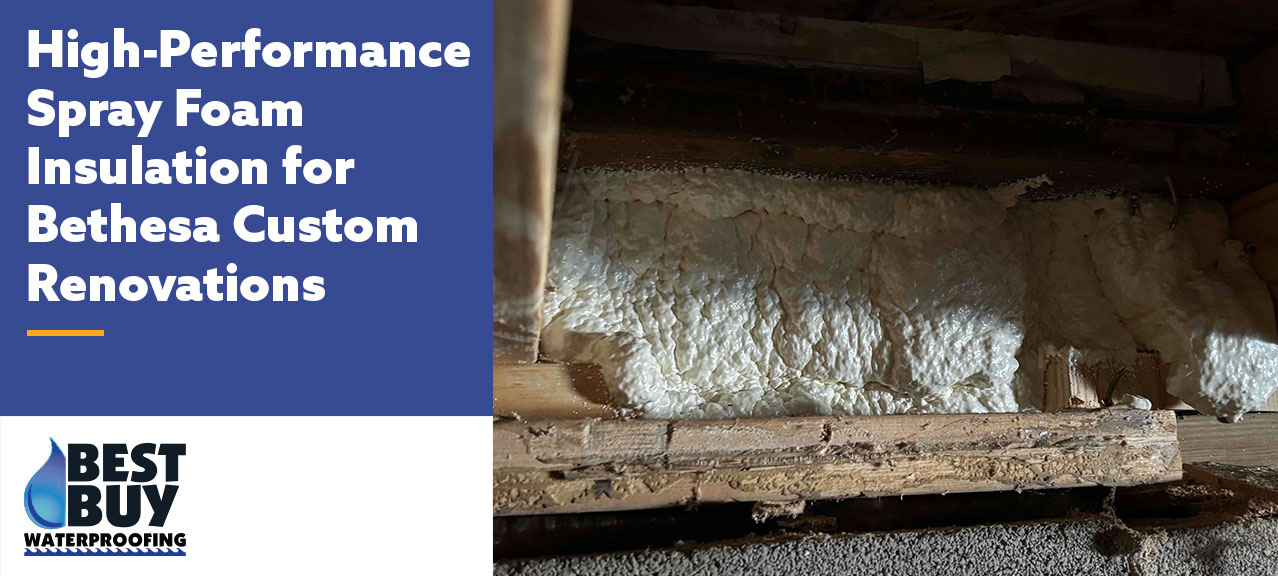
Spray foam insulation during Bethesda renovations gives you a rare opportunity to seal decades of air leaks before the walls close back up. Every Bethesda, Maryland property has a unique footprint, distinct grading, soil composition, and age-related wear, so your custom renovation insulation plan should account for those conditions. High-performance spray foam insulation can reduce heating and cooling costs by up to 30 percent. Proper sealing of rim joists and foundation walls blocks moisture vapor transmission and keeps your renovated home comfortable year-round. Best Buy Waterproofing helps you choose between open-cell and closed-cell spray foam for existing walls and below-grade areas, such as basements or crawl spaces, so your Bethesda home’s insulation performs as intended.
Quick Answer: Why Spray Foam Fits Bethesda Custom Renovations
Many Bethesda renovation projects reach a key stage before drywall goes up: exposed framing gives you a chance to fix insulation problems permanently. Best Buy Waterproofing uses that stage as the starting point for any spray foam insulation Bethesda renovation plan because the work completed before walls close determines the home’s performance for decades.
Spray foam fills exposed framing gaps while adding insulation and air sealing
Spray foam is applied as a liquid that expands into every stud bay, rafter cavity, and awkward framing gap. It then hardens into a continuous barrier. Batts simply sit inside a cavity, but foam adheres directly to the wood. It creates an air seal as it adds thermal resistance. A custom renovation insulation Bethesda project can handle both jobs in one application step instead of two.
Open walls make insulation upgrades easier than a later modernization
Contractors generally reserve full spray foam application in existing homes for major renovations, especially after drywall has been removed. Open framing lets installers see each cavity and apply foam directly with proper technique. It also eliminates the drilling and patching required for injection foam in closed walls. This access makes an active renovation the best time to add high-performance spray foam insulation, rather than treating it as an afterthought after the project ends.
Why each home’s age, grading, soil, and condition call for a custom plan
Every Bethesda property has its own footprint, site conditions, and age-related wear, so insulation plans vary from home to home. A renovation that exposes rim joists or foundation walls may require closed-cell polyurethane insulation applications to seal those areas. This reduces energy loss and blocks moisture vapor transmission. The right foam type and placement depend on what the renovation scope reveals, rather than a one-size-fits-all answer.
Outdated or missing insulation in older Bethesda and Montgomery County homes
Many older homes throughout Bethesda and the wider Montgomery County renovation market were built with little or no wall insulation. Others have fiberglass that has settled and no longer performs as intended. Opening these walls during a renovation gives you a chance to correct decades of gaps before finishing work closes them again.
Not opening walls? Read about spray foam behind drywall or plaster
If your project does not involve opening walls, spray foam is not the right tool for intact drywall or plaster. See our piece on spray foam behind drywall or plaster to learn which options work in that situation.
What Makes Spray Foam High-Performance?
High-performance spray foam insulation in Bethesda renovations comes down to one thing: closed-cell polyurethane insulation that seals rim joists and foundation walls while blocking moisture vapor transmission, instead of only filling a cavity.
Spray foam insulation vs. traditional insulation: air sealing and heat control
Is spray foam better than fiberglass for a renovation? Yes. It air-seals and insulates in one step, which batts and loose-fill insulation cannot do. Rim joists alone account for 15 to 25 percent of a home’s total heat loss, second only to attics. That same connection point causes 80 to 90 percent of basement moisture problems. Closed-cell foam blocks 99 percent of air infiltration when applied there, which closes a gap that traditional insulation cannot reach.
Open-cell vs. closed-cell spray foam: compare R-value, vapor control, uses, and cost in a table
| Factor | Open-Cell | Closed-Cell |
| Density | Soft, flexible | Rigid, dense |
| Moisture resistance | Lower | Higher, blocks moisture vapor transmission |
| Best suited for | Interior walls, upper floors | Basements, crawl spaces, below-grade additions |
| Renovation use case | Mid-renovation wall cavities away from moisture | Below-grade additions, renovated basements, rim joists |
Open-cell foam provides roughly R-3.6 to R-3.8 per inch. Closed-cell foam reaches R-6 to R-7 per inch and has about four times the density.
Is closed-cell spray foam waterproof? Water resistance is not basement waterproofing
Closed-cell spray foam resists water and blocks moisture vapor transmission. It absorbs less than 2 percent water by volume, but it is not a replacement for proper foundation waterproofing. Dedicated drainage and waterproofing systems work best with closed-cell foam in a renovated basement, not as an alternative to it.
Choosing foam for below-grade spaces: open-cell vs. closed-cell guidance
Basements and crawl spaces need closed-cell foam because open-cell’s porous structure absorbs 5 to 10 percent water by volume. See our open-cell vs. closed-cell guidance for a full breakdown.
Where Spray Foam Makes Sense During a Renovation
A renovation affects different parts of a home at different stages, and each area needs an insulation approach based on what is exposed and the risks nearby.
Basement finishing: address leaks with Bethesda basement waterproofing before insulating
Foundation cracks, poor grading, or a failing sump pump often cause basement water problems. Foam can hide these issues, but it cannot fix them. If your renovation has a finished basement, schedule a Bethesda basement waterproofing assessment first. Insulate after you control the water source.
Additions: connect new framing to the existing home’s air barrier
New framing in an addition must connect to the existing home’s air and thermal barrier. It cannot function separately. The band joist and box ends where new construction meets older framing need careful sealing so the addition’s insulation performs continuously with the rest of the house.
Crawl space upgrades: pair insulation with crawl space repair and encapsulation
Spray foam in crawl spaces goes along the band joist and joist boxes. It blocks airflow around the outside perimeter instead of filling every cavity. Pair this work with crawl space repair and encapsulation, including a vapor barrier, to protect against ground moisture and pests for decades.
Rim joists and foundation walls: seal air leaks after any needed foundation repair
The rim joist is the point where a house’s framing sits on the foundation, and it can leak more air than all of a home’s windows combined. After foundation repair is complete, closed-cell foam can seal this connection and close a gap that traditional batt insulation cannot reach.
Plan Installation, Costs, and Contractor Support
Montgomery County requires permits for most structural changes and additions, including work that exposes framing to install insulation. Confirm code requirements with the county’s Department of Permitting Services before work begins to keep your renovation on schedule.
Step 1: inspect the home and confirm Montgomery County permit and code requirements
Best Buy Waterproofing inspects exposed framing, grading, and moisture conditions. The team then confirms permit requirements based on your renovation’s scope.
Step 2: coordinate surface preparation, foam application, and inspections before drywall
Workers apply foam to clean, dry framing according to your contractor’s schedule. Inspections take place before drywall closes the walls.
Step 3: follow ventilation, fire-barrier, and manufacturer re-entry requirements
Codes require a thermal barrier, usually gypsum board, over spray foam in living spaces. Occupants must stay clear during application and curing, often for up to 24 hours.
Cost factors: foam type, thickness, access, removal, and renovation scope
Foam type, thickness, access challenges, existing insulation removal, and how the work fits your renovation timeline affect the project’s scope.
How Best Buy Waterproofing can support your project
Best Buy Waterproofing has operated since 2017 and holds licenses in Maryland, West Virginia, and Pennsylvania. The company coordinates spray foam insulation around active Bethesda renovation timelines. Schedule an assessment to discuss your project.
FAQs
Is spray foam worth it during a renovation? Yes, open walls make installation more economical than a later modernization.
Can spray foam go behind existing drywall? Yes, in some cases.
Open walls provide the best chance to add spray foam insulation. Contact Best Buy Waterproofing to schedule an assessment for your Bethesda renovation.
Conclusion
Open framing during a custom renovation gives you the chance to seal rim joists and foundation walls and prevent moisture vapor transmission over the long term. Your choice between open-cell and closed-cell foam matters, but installation timing matters just as much. Coordinate spray foam insulation with your Bethesda, Maryland renovation schedule to protect your home for decades. Don’t close the walls with outdated insulation. Contact Best Buy Waterproofing to schedule a spray foam assessment today.