
Home » Service Areas » Harrisburg » Harrisburg Spray Foam Insulation
Harrisburg, PA Spray Foam Insulation
- Licensed & Insured
- 5-Star Rated
- Local Business
- Transferable Warranty
Spray Foam Insulation Contractors in Harrisburg, PA
Old brick and stone foundations were built to hold up a house, not to keep it warm. In a Midtown rowhouse or an older detached home on the east side, cold air slips through gaps where the wooden floor framing sits on the masonry, the cellar walls stay clammy, and the first floor never quite warms up from December through March. Those cold spots are where Best Buy Waterproofing focuses its spray foam insulation in Harrisburg, along cellar walls, rim joists and crawl space walls. We use closed-cell spray foam only, and only below grade.
Closed-cell foam fits this job because it does three things in one coat. It insulates, it stops air from moving through cracks and mortar joints, and it does not absorb water the way fiberglass does. Since we are also a waterproofing company, we confirm the walls are dry before any foam goes on. Our own crews have done this work since 2017, and we are insured and licensed in Maryland, Virginia, Washington DC, Pennsylvania, Delaware and West Virginia.
Signs You Need Spray Foam Insulation in Harrisburg
Heat loss through a foundation is easy to miss because it happens out of sight. These clues often point to it in Harrisburg homes.
Cold Air at the Sill
Moving air along the top of the cellar wall on a windy winter day.
Chilly First Floor
Rooms above the basement or crawl space that lag behind the rest of the house.
Clammy Masonry
Basement walls and pipes beading with condensation in humid summer weather.
Batts Falling Down
Old fiberglass that has slumped, darkened or dropped to the floor.
Unusable Basement
A lower level too cold and damp to use for anything but storage.
High Winter Energy Bills
Heating costs that climb while the house still feels drafty.
Spray Foam Insulation Solutions for Harrisburg Homes
Rim Joist Insulation and Air Sealing
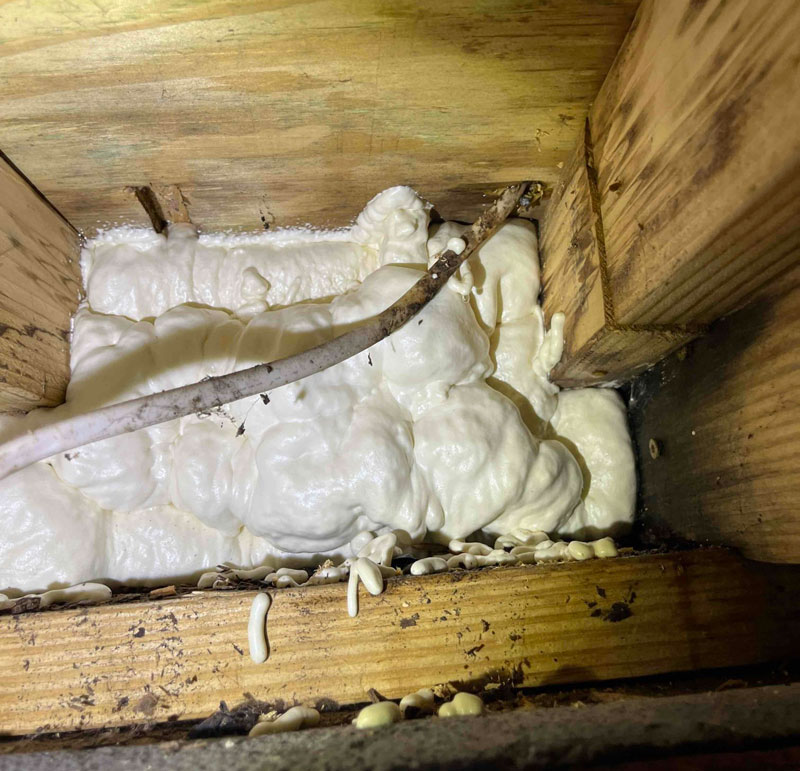
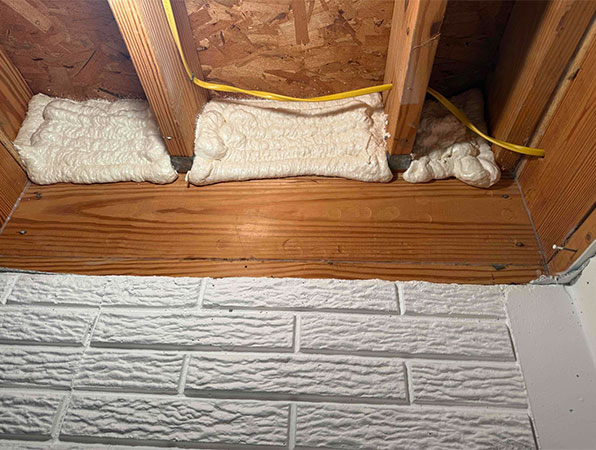
Picture the wooden board that caps the top of the cellar wall and frames the edge of the first floor: that is the rim joist. In older houses it is often bare or stuffed with a little loose fiberglass, and outside air pours through the gaps where wood meets masonry. Rim joist insulation with closed-cell spray foam fills each bay between the joists, sealing those gaps and insulating the band in a single application.
For many Harrisburg homes this is the place to start. It is a compact project, it tackles one of the biggest sources of drafts in the house, and in a rowhouse it covers the front and rear walls where most of the outside exposure is.
Basement Wall Insulation
Bare foundation walls lose heat to the cold ground all winter and gather condensation all summer. We spray closed-cell foam directly onto poured concrete, block, brick or stone, where it expands into mortar joints, small voids and uneven surfaces to form one continuous layer. That layer insulates, blocks air movement and acts as a vapor barrier, so humid basement air never touches the cold masonry behind it.
This kind of basement insulation turns a raw cellar into a space that holds its temperature, and it gives you a solid starting point if you later decide to finish the room.
Crawl Space Wall Insulation
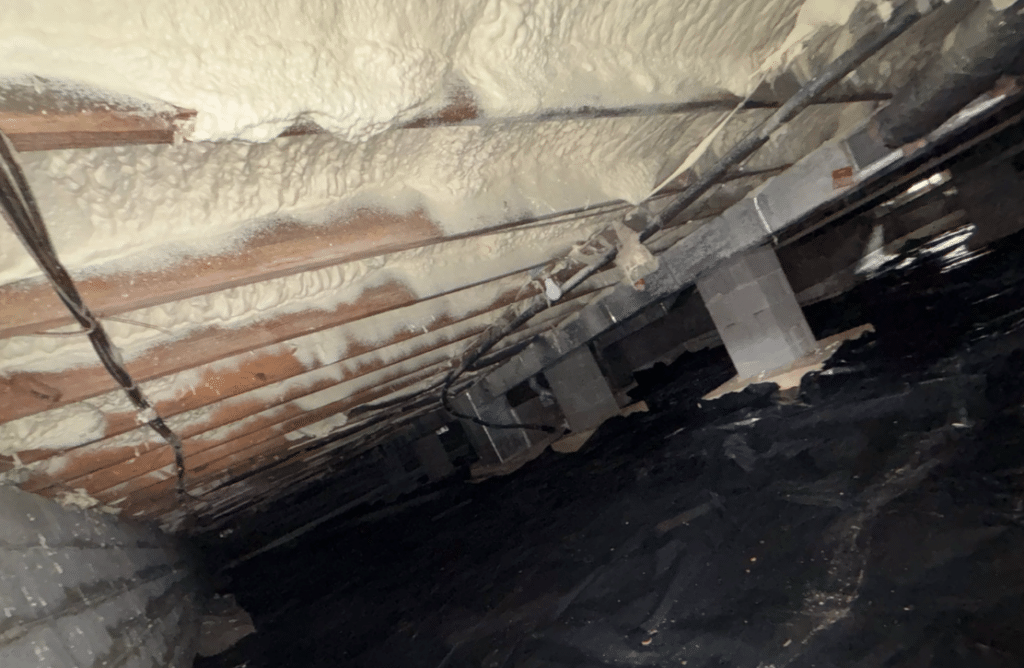
Rear kitchens and additions in Harrisburg often sit over a shallow crawl space, and the floors above them are usually the coldest in the house. Fiberglass hung between the joists down there tends to soak up moisture and fall out within a few seasons. We insulate the crawl space walls and rim joists with closed-cell foam instead, which keeps cold air out at the perimeter and does not break down in a damp environment.
Crawl space insulation on the walls works best once the vents are closed and the space is sealed, so we usually pair it with a liner and humidity control.
Foam Within a Sealed Crawl Space
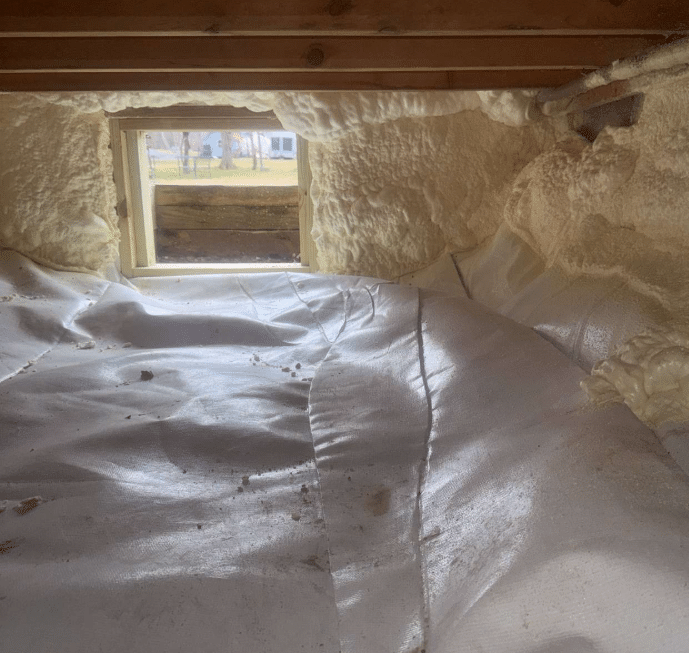
Insulation in a crawl space is only one part of keeping that area healthy. In a full encapsulation, we lay a heavy liner over the soil and up the walls, close the vents, spray foam on the walls and rim joists and add a dehumidifier to control the air. Each piece supports the others: the liner blocks ground moisture, the foam handles temperature and air leaks, and the dehumidifier keeps humidity steady through the summer.
If your crawl space is already wet, we address the water first, then insulate as part of the sealed system.
Dry Walls Before Any Foam
Spray foam should never go over a wall that leaks. Water trapped behind insulation keeps the masonry wet, and the leak continues unseen. That is why every spray foam insulation project we take on starts with a moisture check. If we find active seepage through old mortar or a crack, we explain how to stop it with drainage, a sump pump or crack repair before insulating.
Having one team handle both waterproofing and insulation means the work happens in the right order, and you are not left coordinating two companies on the same wall.
Our Spray Foam Insulation Process
Free Inspection
We check for leaks, measure humidity and locate drafts around the foundation.
Your Recommendation
We walk you through what we found and what we recommend to insulate below grade.
Foam Application
Our crew preps and protects the area, then sprays the walls and rim joists.
Warranty Protection
Your installation is backed by our transferable warranty.
Why Harrisburg Homeowners Choose Best Buy Waterproofing
Insulating a foundation is part comfort project, part moisture project. Harrisburg homeowners get spray foam insulation from a team that understands both and checks for water first.
- Working since 2017: Below-grade insulation and waterproofing have been our trade since 2017.
- Licensed and insured: Licensed in Maryland, Virginia, Washington DC, Pennsylvania, Delaware and West Virginia, and insured.
- Below grade only: We focus on basements and crawl spaces, where moisture and insulation meet.
- Transferable warranty: The coverage stays with your home through a sale.
- Free inspection, financing: We look at no charge, offer financing and are reachable 24/7.
What Affects the Cost of Spray Foam Insulation in Harrisburg?
Foam projects vary with the size of the space and what has to happen before spraying, so we do not use a price list. A free inspection of your Harrisburg home leads to a firm price for your project.
Area Covered
How many feet of wall and rim joist get foam.
Foam Thickness
Thicker coverage uses more material and adds insulating value.
Old Insulation Removal
Wet or fallen batts and debris must be cleared out first.
Moisture Repairs
Any leaks need fixing before the foam is applied.
Access and Clearance
Low crawl spaces and cramped cellars take more time to spray.
Foundation Surface
Rough stone and brick take more prep than smooth poured walls.
Spray Foam Insulation FAQs
Why closed-cell foam instead of fiberglass in a basement?
Fiberglass works poorly against cool, damp masonry. It holds moisture, slumps and lets air pass through, and condensation can form behind it. Closed-cell spray foam bonds to the wall, resists water, blocks air movement and serves as a vapor barrier, so it keeps insulating in the conditions found in most Harrisburg basements and crawl spaces.
Can foam go on an old stone or brick foundation?
Yes. Closed-cell foam bonds to stone and brick and fills the uneven joints between them, which is where much of the air leakage happens. The condition that matters is moisture: the wall has to be dry. If water is coming through the mortar, we handle that first.
Will spray foam lower my energy bills?
Sealing and insulating the rim joist and foundation walls cuts the drafts and heat loss that make heating systems run longer, so many homeowners see lower energy bills and more even temperatures. Results vary with the house, how leaky it was before and how you heat it, so we avoid promising a specific number.
Will it stop condensation on my basement walls?
In most cases, yes. Summer condensation forms when humid air meets a cool wall. Closed-cell foam keeps that air off the masonry, so the moisture has nowhere to collect. If the basement air stays very humid, a dehumidifier can help as well.
Do you insulate attics?
No. We keep our foam below the first floor, in cellars and crawl spaces, on the masonry and the band of framing that rests on it. That is where insulation and moisture control overlap, and it is the work our team specializes in.
Can I finish my basement after the foam goes in?
Yes. Foam on the walls and rim joists gives you an insulated, air-sealed shell to build on. We also offer basement finishing as a separate service, and we can plan the insulation with a future finished room in mind.
More Services in Harrisburg
Spray foam insulation near Harrisburg, PA: Camp Hill · Hershey · Mechanicsburg · Carlisle · Lemoyne · New Cumberland · Hummelstown
Warm Up Your Lower Level
If cold air is pouring in along the foundation or the cellar walls sweat all summer, spray foam can help. Schedule a free inspection of your Harrisburg home, and we will walk you through what we found and what we recommend. Financing is available.