
Not every foundation crack needs the same fix. The right repair depends entirely on what’s causing the crack — and getting that wrong is exactly why so many patches fail the first time around.
Here’s the short version: epoxy bonds stable, dry cracks, while urethane stays flexible enough to stop active leaks. Knowing which one your home actually needs matters more than the injection method itself.
DC rowhouse foundation cracks don’t behave the same way as cracks in newer builds. Piedmont clay soil sits beneath much of the District, and it expands when wet and shrinks when dry — stressing your foundation walls season after season. Stair-step cracks in brick foundations often point to settlement, while vertical and horizontal cracks each tell a very different story.
Below, we’ll walk through what each crack type means, which repair methods actually hold up, and when it’s time to call in a professional.
Why DC Foundations Crack Differently
Most foundation problems in Washington DC start before you ever see a crack. They start underground — with Piedmont clay, the soil type sitting beneath much of the District.
Piedmont clay absorbs water like a sponge when it’s wet, then shrinks as it dries out. That cycle repeats every single season. When saturated, clay soil can swell up to 15% in volume, lifting sections of your foundation in a process engineers call heaving. Some deposits push even further — up to 30% in volume — generating pressure as high as 15,000 pounds per square foot against a concrete wall. That’s not a small force. Expansive soils cause more financial damage to structures nationwide each year than floods, hurricanes, tornadoes, and earthquakes combined.
Piedmont Clay, Poor Drainage, and What Happens to Your Foundation
Poor drainage makes all of this worse. When water isn’t moving away from your home properly, it pools against the foundation and the clay underneath absorbs it unevenly. One section of your wall may be sitting over saturated, swollen soil while another section rests on dry, shrunken ground. That mismatch — what’s called differential pressure — is behind most of the settling we see in DC homes.
The usual culprits are familiar: clogged gutters, downspouts that dump water too close to the house, and yards that slope toward the foundation instead of away from it. Any one of these keeps feeding that wet-dry cycle, and your foundation walls take the stress.
Brick Rowhouses and Poured-Concrete Homes Don’t Crack the Same Way
DC’s housing stock tells two very different structural stories, and that matters when it comes to repairs.
Older rowhouses were built so that the side walls — made of brick — carry the weight of floors and roof down to the foundation. Floor joists were often mortised directly into those brick walls, making the masonry a structural element, not just a decorative one. That’s a fundamentally different setup than poured-concrete foundations built after the 1940s, which use steel reinforcement and continuous footings instead of brick coursework. Poured concrete took over as the standard between the 1950s and 1980s because it was faster and more uniform to build.
Why does this matter? Brick absorbs and releases moisture differently than poured concrete. A crack that’s purely cosmetic in a newer concrete wall can signal something structural in a 100-year-old brick rowhouse. That’s exactly why the repair approach needs to match the home — not just the crack.
Common Crack Types in DC Homes
Foundation cracks aren’t all created equal. The pattern matters — it tells you whether you’re looking at something cosmetic or something that needs attention right away. DC homes tend to show three patterns more than any others.
Stair-Step Cracks in Brick Rowhouse Foundations
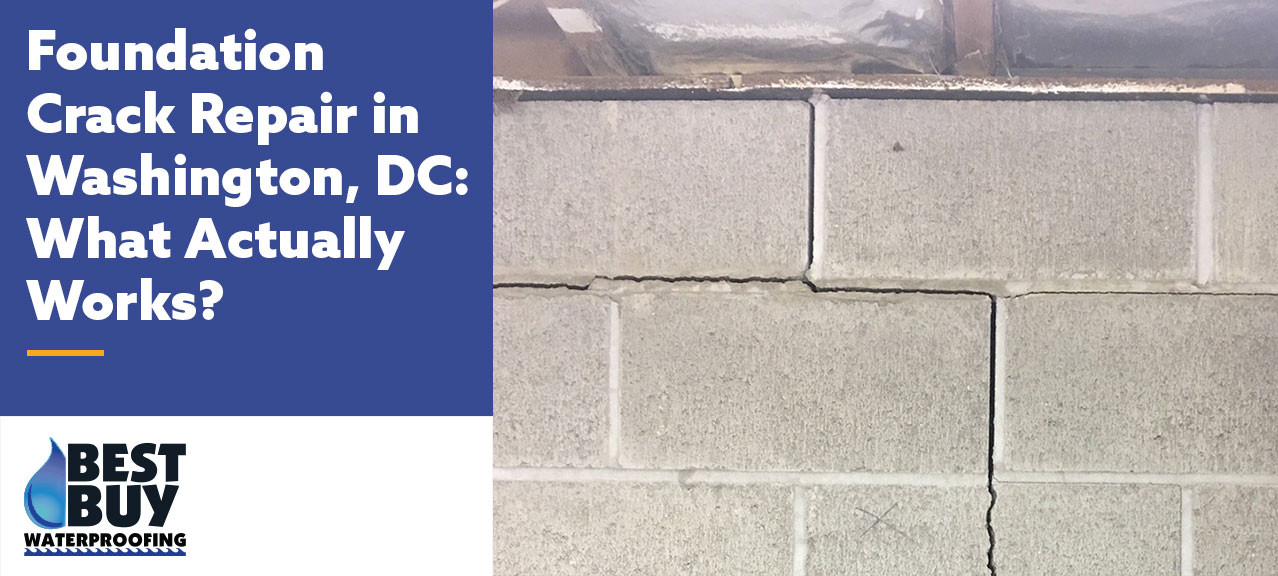
Picture a crack zigzagging up a brick wall, stepping through the mortar joints rather than cutting straight through the brick itself. That’s a stair-step crack. You’ll most often find them near corners, windows, and doorways — the spots where a wall absorbs the most stress. The pattern signals that one section of the foundation has shifted relative to another, which points to differential settlement, not just normal aging.
That said, not every stair-step crack is cause for alarm. Mortar is actually designed as the “sacrificial” material — it absorbs movement so the brick doesn’t have to. Hairline mortar cracks that stay small and stable for months usually fall into that category.
Settlement-driven cracks are a different story. They widen past a quarter inch, stretch across several courses of brick, and keep growing with each season.
Here’s a simple way to tell which one you’re dealing with: tape over the crack, write down the date and width, and check back in four to six weeks. If the tape tears or the gap has grown, you’re looking at active DC rowhouse foundation cracks — and that calls for a professional inspection, not a tub of mortar mix.
Vertical Cracks in Poured Basement Walls
Poured concrete foundations crack differently than brick. Vertical and diagonal cracks are the most common type, and many appear within the first month as the concrete cures and settles. Look for them near egress window corners, along cold joints where separate pours meet, or around utility penetrations and tie rods.
Most stay narrow — generally under 1/8 inch — and since the wall’s load passes around the opening on either side, they rarely threaten structural capacity.
But narrow doesn’t mean harmless. Even a hairline vertical crack can let in water, soil gas, and humidity. That’s why these cracks are strong candidates for urethane crack injection rather than a surface patch. More on that in the next section.
Horizontal Cracks and Bowing from Soil Pressure
Of the three crack types, horizontal cracks deserve the most attention — full stop.
When a crack runs through the midsection of a basement wall, it’s almost always tied to hydrostatic pressure or expansive clay pushing in from outside, not curing or minor settling [113]. Watch for a crack wider than 1/4 inch, visible bowing, or a crack that spans the full width of the wall. Any of those signs points to a structural issue, not a cosmetic one.
Left unaddressed, that pressure creates a rotational shear plane — weakening the connection between the footing and the framing above it. At that stage, epoxy or urethane alone won’t be enough. What’s typically needed are wall anchors or carbon-fiber reinforcement, a form of foundation wall stabilization we’ll cover next.
What Actually Works: Repair Methods for Historic and Newer Homes
Once you know what type of crack you’re dealing with, the next step is matching it to the right repair. This is where most DIY attempts go wrong — not because homeowners don’t try, but because each method is built to solve a specific problem. Use the wrong one, and the crack comes right back.
Urethane crack injection is the go-to for active leaks. It reacts with moisture to expand and seal, and it stays flexible enough to move with the wall over time. That flexibility is the point. It won’t restore structural strength, though — so if your wall is bowing, urethane alone won’t stop that.
Epoxy injection is a different tool entirely. It creates a rigid bond that’s actually stronger than the surrounding concrete, which makes it ideal for stable, dry cracks. The catch? It needs dry conditions to cure properly, and if the wall keeps shifting, epoxy will crack again.
When a crack is showing signs of ongoing lateral pressure, injection isn’t enough on its own. Wall anchors are the right call for walls that have bowed more than two inches. For earlier-stage movement under that threshold, carbon fiber straps stabilize the wall without the need for excavation.
Brick rowhouses need a separate conversation. Using poured-concrete repair materials on historic masonry can trap moisture against the brick and cause more damage than the original crack. Compatible mortar and masonry repair products matter here.
A word on surface patches — caulk, hydraulic cement, and similar products only cover the symptom. Without addressing drainage or underlying movement, the same crack reopens, sometimes worse than before.
For a side-by-side breakdown of injection materials versus coatings, take a look at our crack injection vs. Drylok comparison.
When to Call a Professional: Inspection and FAQs
We know foundation cracks can be stressful — especially when you’re not sure what you’re looking at. Here’s a straightforward guide to when it’s time to stop watching and start calling.
Schedule an inspection when you notice any of these:
- Horizontal cracking anywhere along a basement wall
- Stair-step patterns in brick or masonry
- Any crack wider than a quarter inch
- A door or window that’s suddenly sticking — that’s often a sign your foundation has shifted
A single hairline crack rarely signals serious trouble. But several appearing together, or one that keeps widening season after season, means your foundation needs a trained eye — not a tube of caulk.
What causes foundation cracks in DC homes specifically?
Piedmont clay soil is the biggest culprit. Add poor drainage and the age of rowhouse construction, and you have a recipe for seasonal stress on your foundation walls — wet-dry cycles that repeat year after year.
Can a rowhouse foundation crack be repaired without touching the historic facade?
Yes. Injection methods work from the interior or through targeted exterior ports, so your brick coursework and parged stone finishes stay intact. No large-scale facade removal needed.
Is epoxy or urethane better for a DC basement?
It depends on the crack. Epoxy suits stable, dry cracks under 1/8 inch — it bonds with a strength that actually exceeds the surrounding concrete. Urethane is the right call for active leaks, since it stays flexible and expands with moisture.
How much does foundation crack repair cost in Washington, DC?
There’s no single answer — cost depends on the crack type, wall material, and whether structural reinforcement is involved. A professional inspection gives you an accurate number based on your specific home, with no guesswork.
Not sure what you’re dealing with? Best Buy Waterproofing offers free inspections. You’ll meet with a certified waterproofing inspector — not a salesperson — and get a straight answer about what your foundation actually needs.
Call us today at 844.980.3707 or fill out the form below to schedule your free inspection.
Let’s Get Your Foundation the Right Fix
Getting foundation crack repair right in Washington DC starts with understanding what you’re actually dealing with. Piedmont clay soil, rowhouse construction, and drainage problems all play a role — and they shape whether epoxy, urethane, or wall stabilization is the right call for your home.
A hairline vertical crack and a bowing wall are very different problems. They need very different solutions.
Best Buy Waterproofing can inspect your foundation, identify what’s causing the damage, and recommend a repair that actually lasts — not just one that covers it up. Contact us today for a no-pressure free inspection and get the peace of mind that comes with knowing your home is in good hands.